
High School English · Mark Twain
The Adventures of Tom Sawyer
A whitewashed fence, a midnight murder, three runaway pirates, and a cave with no way out.
The book opens with a shout: “Tom!” No answer. Aunt Polly is hunting for her nephew again, and within a page she has caught him in the jam closet, reached for a switch, and lost him over the fence. That is Tom Sawyer: quick, cunning, theatrical, always in trouble and nearly always talking his way out of it.
Mark Twain published The Adventures of Tom Sawyer in 1876. It is set in St. Petersburg, a small Missouri river town based on Hannibal, where Twain grew up. In his preface he says that most of the adventures “really occurred,” and that the story takes place “thirty or forty years ago,” in the 1830s or 1840s. It starts as a comedy about a boy who hates school and Sunday clothes. Then Tom and his friend Huck Finn watch a murder in a graveyard, and the summer gets much darker.
On this page: the story in brief, the people of St. Petersburg, a guide to all 35 chapters and the Conclusion, the big themes, how Twain’s humor works, a careful look at Injun Joe and the book’s language, the history behind it, how it leads into Huckleberry Finn, a summer-order game, a quiz, and questions to argue about.
Before you read. The book’s villain is a man of mixed Native American and white ancestry whom the novel calls only “Injun Joe,” a mocking form of “Indian.” Twain draws him as a stereotype, and the book ties his crimes to his “Injun blood,” his own words in the graveyard. The book also uses a racial slur for Black people nine times. We do not repeat that word on this page; when it matters we call it “the slur.” There is a murder in a graveyard, a threat to mutilate a woman, and a man who dies of starvation in a cave. Talk with your teacher or a family member about anything that troubles you. Our section on Injun Joe and the book’s language explains what the book does and why it matters.
The Story in Brief
Tom Sawyer lives with his Aunt Polly, his well-behaved half-brother Sid and his cousin Mary in the river village of St. Petersburg. Twain never tells us Tom’s exact age. He skips school, fights new boys, and trades for marbles and bits of junk. When Aunt Polly sentences him to whitewash thirty yards of fence on a Saturday, he tricks the other boys into paying him for the privilege of doing the job.
Tom falls for Becky Thatcher, the judge’s daughter who has just moved to town. He also admires Huckleberry Finn, the son of the town drunk, who sleeps where he likes and never has to wash or go to school. One midnight Tom and Huck sneak into the graveyard to try a cure for warts with a dead cat. They see three men robbing a grave: young Dr. Robinson, the harmless drunk Muff Potter, and Injun Joe. A fight breaks out, and Injun Joe stabs the doctor with Potter’s knife, then convinces the dazed Potter that he did it himself. Terrified of Joe, the boys swear in blood never to tell.
Guilty and heartsick, Tom runs away with Huck and Joe Harper to be pirates on Jackson’s Island. The town decides they have drowned. The boys slip back on the day of their funeral and walk into church in the middle of their own funeral sermon.
At Muff Potter’s murder trial, Tom’s conscience wins. He testifies that Injun Joe was the killer, and Joe leaps through the courtroom window and escapes. Later, hunting for buried treasure in a haunted house, Tom and Huck watch Injun Joe, disguised as a deaf and mute Spaniard, dig up a box of gold. Huck follows him one night and overhears his plan for revenge on the Widow Douglas. Huck runs for help to the Welshman’s house, and the attack is stopped.
At a picnic, Tom and Becky wander too deep into McDougal’s cave and are lost for days. In the dark Tom sees Injun Joe, who is hiding there. Tom finally finds a way out. Becky’s father then has the cave door sealed with iron, not knowing Joe is inside. When Tom hears this, the town rushes to the cave and finds Injun Joe dead of starvation behind the door. Tom and Huck go back into the cave and find the gold: a little over twelve thousand dollars. The Widow Douglas takes Huck in to raise him properly, and he can barely stand it. Tom talks him into staying by promising that respectable boys can still join his new robber gang.
Characters
St. Petersburg is a small place. These are the people to know.
Tom’s household
- Tom Sawyer
- Clever, vain, imaginative and big-hearted. He lives by the rules of the adventure books he loves. Twain says in the preface that Tom is drawn from life, but from three boys he knew, not one.
- Aunt Polly
- Tom’s aunt, who is raising him. Strict, easily fooled, and deeply loving. She worries that sparing the rod will ruin Tom, and she can hardly bring herself to use it.
- Sid
- Tom’s “younger brother (or rather half-brother),” a model boy and a tattletale.
- Mary
- Tom’s kind older cousin, who helps him learn his Bible verses.
Tom’s friends
- Huckleberry Finn
- The “juvenile pariah of the village,” son of the town drunk. Free of school, church and soap, he is every mother’s warning and every boy’s envy. Loyal and practical, he becomes the hero of the sequel.
- Becky Thatcher
- Judge Thatcher’s daughter, new in town. Tom shows off for her, gets “engaged” to her, and takes a whipping for her. Wikipedia’s character list notes that she was based on Laura Hawkins, a friend of Samuel Clemens.
- Joe Harper
- Tom’s best friend, a fellow general and pirate.
- Ben Rogers and the fence boys
- Ben is the first boy tricked into paying to whitewash the fence. Billy Fisher, Johnny Miller and others follow.
The grown-ups in town
- Judge Thatcher
- Becky’s father, a county judge from Constantinople, twelve miles away. He has the cave door sealed.
- Mr. Dobbins
- The schoolmaster, quick with the switch, who secretly wanted to be a doctor and keeps an anatomy book locked in his desk.
- Widow Douglas
- Kind and wealthy. Injun Joe plans revenge on her because her late husband, a justice of the peace, had him jailed and horsewhipped. She later takes Huck in.
- The Welshman (Mr. Jones)
- An old man who lives on Cardiff Hill with his sons. When Huck brings the alarm, they drive off the attackers.
The graveyard and after
- Injun Joe
- The villain. He murders Dr. Robinson, frames Muff Potter, and swears revenge on anyone who crosses him. See our section on how the book portrays him.
- Muff Potter
- A gentle, harmless drunk who is framed for the murder and nearly hanged.
- Dr. Robinson
- A young doctor who hires Potter and Injun Joe to dig up a body for him. Five years earlier he had driven Joe away from his father’s kitchen.
Chapter Guide
All 35 chapters and the Conclusion, grouped by where the story goes. The summaries are our own; we checked them, and every quotation, against the Project Gutenberg text (eBook #74).
Part 1 · A Summer of Mischief
Chapters 1–8 · Fence, school and church
- Chapter 1
“Y-o-u-u Tom”
Aunt Polly catches Tom in the jam closet and calls for the switch, but he escapes over the fence. He skips school to go swimming, nearly fools her about it, and fights a well-dressed new boy. Polly decides he will work on Saturday as punishment.
Watch for: Aunt Polly’s inner argument between duty and love. - Chapter 2
The Fence
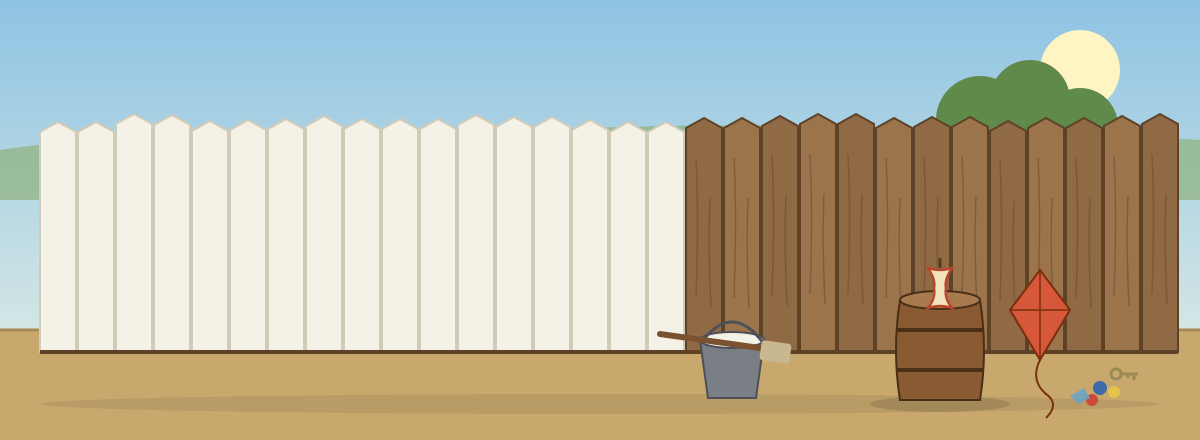
Facing “Thirty yards of board fence nine feet high,” Tom tries to bribe Jim, a young Black boy sent for water, until Aunt Polly stops it. Then he pretends to love the work. Ben Rogers gives up his apple for a turn with the brush, and by afternoon Tom is rich in marbles, a kite and a dead rat.
Watch for: the narrator’s “law” about work and play. - Chapter 3
General Tom and the New Girl
Tom leads a mock battle against Joe Harper’s army. He spots a pretty new girl in a garden and shows off for her. At supper, Sid breaks the sugar-bowl and Aunt Polly smacks Tom, then cannot bring herself to apologize.
- Chapter 4
Sunday School
Tom trades his fence treasures for tickets that should prove he learned two thousand Bible verses, and claims the prize Bible in front of Judge Thatcher. Asked the names of the first two disciples, he answers “David and Goliah!”
Watch for: “Let us draw the curtain of charity over the rest of the scene.” - Chapter 5
The Pinchbug
A dull sermon is rescued when Tom’s pinchbug bites a stray poodle, which goes howling through the church.
- Chapter 6
Huck, Warts and Becky
Tom fakes a dying toe to skip school and loses a loose tooth instead. He meets Huck Finn carrying a dead cat, a cure for warts if taken to a graveyard at midnight. Late to school, Tom confesses to talking with Huck so he will be whipped and sent to sit on the girls’ side, beside Becky Thatcher.
Watch for: the boys’ elaborate superstitions, told as solemn science. - Chapter 7
Engaged
Tom and Joe race a tick across a slate. At noon Tom gets Becky to become “engaged” to him, then lets slip that he was once engaged to Amy Lawrence. Becky refuses his greatest treasure, a brass knob from the top of an andiron.
- Chapter 8
Robin Hood
Heartbroken, Tom dreams of becoming a pirate or a soldier, then plays Robin Hood with Joe in the woods.
Watch for: the boys would rather be outlaws “than President of the United States forever.”
Part 2 · The Graveyard Secret
Chapters 9–12 · A murder and a vow
- Chapter 9
Midnight in the Graveyard
Tom and Huck watch Dr. Robinson, Muff Potter and Injun Joe dig up a grave. The men quarrel over pay. Joe recalls being jailed as a vagrant after the doctor’s father drove him away. In the fight, Joe kills the doctor with Potter’s knife and puts it in the unconscious Potter’s hand.
Watch for: Joe blames his own “Injun blood.” Who else in the book blames it? - Chapter 10
The Blood Oath
The boys swear in blood never to tell. A stray dog howls nearby, which they take as a sign of death. At home, Aunt Polly’s tears hurt Tom more than any whipping, and Becky returns his brass andiron knob.
- Chapter 11
Potter Accused
The body is found, and Potter is caught. Injun Joe calmly lies to the crowd, and the boys keep silent, sure Joe has sold himself to the devil. Tom sleeps badly and secretly slips small comforts to Potter at the jail window.
Watch for: Tom’s conscience at work. - Chapter 12
The Pain-killer
Becky is sick and stays home, and Tom mopes. Aunt Polly doses him with every patent medicine she reads about. He feeds the Pain-killer to the cat, Peter, who explodes around the room. When Becky returns, Tom shows off, and she snubs him.
Part 3 · Pirates of Jackson’s Island
Chapters 13–17 · Runaways and a funeral
- Chapter 13
The Black Avenger
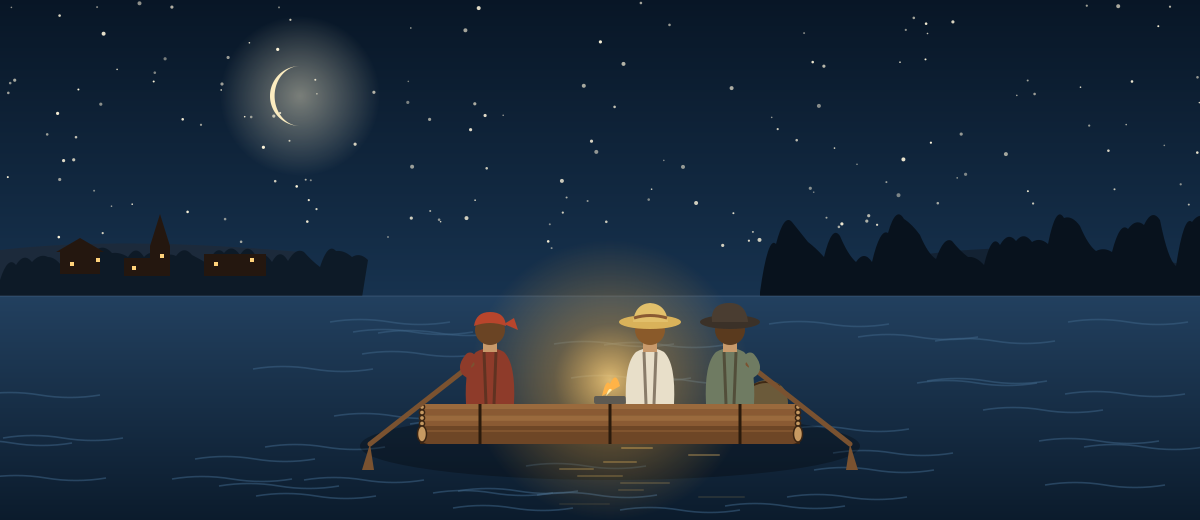
Tom, Joe Harper and Huck capture a small log raft at midnight and steer it to Jackson’s Island, as the Black Avenger of the Spanish Main and his crew. That night their consciences trouble them about running away and about the stolen meat.
- Chapter 14
The Cannon
A ferryboat fires a cannon over the water to raise their drowned bodies, and the boys realize the town is looking for them. That night Tom writes on two pieces of sycamore bark and steals away from camp.
- Chapter 15
Tom Goes Home
Tom swims and rides the ferry back and hides under Aunt Polly’s bed. He hears his family and Mrs. Harper mourn the boys and plan their funeral for Sunday. He almost leaves the bark message, then keeps it and returns to the island.
- Chapter 16
Pirate Life
The boys dig turtle eggs, learn to smoke pipes and get sick, and get homesick. A wild storm nearly blows the camp away. Tom reveals a secret plan that keeps the others from going home.
- Chapter 17
Their Own Funeral
The town mourns. In the middle of the funeral sermon the three “dead” boys march up the church aisle; they had been hiding in the gallery the whole time.
Watch for: the sermon, which praises the boys for virtues they never had.
Part 4 · School, Becky and the Trial
Chapters 18–24 · Tom takes the blame and tells the truth
- Chapter 18
The “Dream”
Tom claims he dreamed what his family said while he was hidden. He and Becky make each other jealous, she with Alfred Temple. Alfred takes revenge by pouring ink on Tom’s spelling-book, and Becky, who sees it, decides not to tell.
- Chapter 19
The Bark
Aunt Polly learns the “dream” was a trick and is hurt. Tom says he came home to tell her the boys were safe. She finds the bark in his jacket pocket and forgives him.
- Chapter 20
“I done it!”
Becky accidentally tears a page in Mr. Dobbins’s secret anatomy book. When he demands to know who did it, Tom jumps up and says “I done it!” and takes her whipping. Becky tells him about Alfred’s ink.
Watch for: Becky’s line, “Tom, how could you be so noble!” - Chapter 21
Examination Day
The school shows off its recitations and painfully sentimental “compositions.” The boys take revenge on Mr. Dobbins: a cat lowered from the garret grabs his wig and reveals a bald head that the signpainter’s boy has painted gold.
Watch for: Twain’s note that the compositions are real, taken from a published volume. - Chapter 22
Measles and a Revival
Tom joins the Cadets of Temperance for the red sash and quits. The summer drags. Then come the measles. A religious revival converts all his friends, and a thunderstorm convinces Tom it is aimed at him. When he recovers, everyone has backslid.
- Chapter 23
The Trial
Tom and Huck visit Potter, who thanks them for their kindness. At the trial, Tom is called as a surprise witness and tells what he saw. Injun Joe springs out of a window and escapes.
- Chapter 24
Hero by Day
Tom is the village hero, and the town that wanted to hang Potter now fusses over him. But Tom’s nights are “seasons of horror,” and Huck is afraid too. A detective from St. Louis finds only “a clew.”
Part 5 · Treasure Hunting
Chapters 25–30 · Gold, a disguise and a rescue
- Chapter 25
Digging for Treasure
Tom gets “a raging desire to go somewhere and dig for hidden treasure.” He and Huck dig under a dead tree and find nothing, so they plan to try the haunted house.
- Chapter 26
The Haunted House
Hiding upstairs, the boys watch two men come in: a ragged stranger and a “deaf and dumb” old Spaniard who turns out to be Injun Joe. Digging, the men find a box of gold coins and take it away to hide it in “Number Two—under the cross.” Joe also mentions revenge.
- Chapter 27
The Young Detectives
Tom wakes up thinking it was a dream. The boys guess “Number Two” is a room in a tavern and find one at the Temperance Tavern that is kept locked.
- Chapter 28
Room No. 2
On a stormy night Tom sneaks to the room with a pocketful of keys, including his aunt’s, and finds Injun Joe asleep on the floor, drunk. The room is full of whiskey barrels and bottles: the “Temperance” Tavern’s secret. The boys agree that Huck will keep watch every night.
- Chapter 29
The Picnic and the Widow
Becky’s class picnics at McDougal’s cave. That night Huck follows the two men up Cardiff Hill and hears Joe’s plan to cut and mutilate the Widow Douglas’s face, out of revenge on her dead husband. Huck runs to the Welshman, whose family drives the men off.
- Chapter 30
Huck Lets It Slip
Huck lets slip to the Welshman that the “Spaniard” is Injun Joe. Then the town realizes Tom and Becky never came back from the cave. The men search for days while Huck lies ill with fever at the Welshman’s house.
Part 6 · The Cave and the Treasure
Chapters 31–35 and the Conclusion
- Chapter 31
Lost in the Cave
Tom and Becky wander beyond the familiar passages. A bat puts out her candle, their candles run out, and they are lost in total darkness. Exploring with a kite-line, Tom sees a hand holding a candle: Injun Joe. Joe runs, and Tom keeps the meeting secret from Becky.
- Chapter 32
The Way Out
Tom follows the kite-line to a speck of daylight and the “broad Mississippi.” The town celebrates. Two weeks later Judge Thatcher mentions that he had the big door sheathed with iron and “triple-locked.” Tom turns white: “Injun Joe’s in the cave!”
- Chapter 33
The Fate of Injun Joe
Injun Joe lies dead just inside the door; he had hacked at it with his knife and starved. Crowds come to his funeral. Tom and Huck go back to the cave, find a cross smoked on the rock, and dig out the gold. They are swept off to a party at the Widow Douglas’s house.
Watch for: the narrator’s scorn for the people who signed a petition to pardon Joe. - Chapter 34
Springing a Secret
The Welshman reveals Huck as the widow’s rescuer, and she announces that she will take him in. Tom’s news tops it all: he pours out the gold, which comes to a little over twelve thousand dollars.
- Chapter 35
Poor Huck
The money is invested for the boys. Living with the widow, Huck is miserable and runs back to his old sugar hogshead. Tom persuades him to return by saying a robber gang only takes respectable members.
Watch for: “I’ll stick to the widder till I rot, Tom.” - Conclusion
So Endeth This Chronicle
Twain stops the story because it is “strictly a history of a boy,” and hints that he might someday tell what became of the younger characters.
Themes
Childhood and freedom
The book is a long summer. Tom’s world is split between duty (school, church, chores, clean collars) and freedom (the river, the island, the woods). Huck stands for total freedom, and even he finds the widow’s rules unbearable. Twain says in the preface that he hoped to remind adults “of what they once were themselves.”
Ask: Is Tom free, or is he just following different rules, from his books?
Superstition
Dead cats cure warts at midnight. A howling stray dog means death. Treasure is buried under dead trees, and you never dig on a Friday. Twain’s preface says these beliefs were common among “children and slaves in the West” at the time. The boys’ superstitions are funny, but they also show how people try to control a world that frightens them.
Ask: Where do the adults believe things that are just as silly?
Respectability and hypocrisy
Sunday school prizes go to whoever has the most tickets, not the most knowledge. Grown-ups at church show off just as much as Tom does. A sermon praises the “dead” boys for virtues they never had. The town swings from hating Muff Potter to loving him. Twain keeps asking whether being respectable is the same as being good.
Ask: Who is the most honest person in town? Can you make a case for Huck?
Justice and Injun Joe’s trial
Muff Potter is nearly hanged for a crime he did not commit, because a crowd believes what it is told. Tom has to choose between his oath and an innocent man’s life. The trial is the moral center of the book. Its ending is less tidy: Joe dies alone in the sealed cave, and the town treats his funeral like a show.
Ask: Does the book give Injun Joe the same justice it demands for Potter?
Growing up
Tom starts the book as a performer, always playing to an audience. By the end, he lies to protect Becky, tells the truth to save Potter, and keeps Becky alive in the cave. Twain ends it there, he says, before it becomes “the history of a man.”
Reading and imagination
Tom plays at pirates, Robin Hood and robber gangs, always “by the book.” His imagination makes life exciting and gets him into real danger. Twain is also teasing the romantic adventure stories that Tom loves.
Twain’s Humor
The fence
Tom’s Saturday punishment is the most famous scene in the book. When Ben Rogers comes by to tease him about working, Tom acts as if whitewashing were an art:
“Like it? Well, I don’t see why I oughtn’t to like it. Does a boy get a chance to whitewash a fence every day?”
Ben ends up paying an apple to take a turn. Then the narrator steps in as a mock philosopher, with a “law” that is half joke and half truth:
“Work consists of whatever a body is obliged to do, and that Play consists of whatever a body is not obliged to do.”
The joke is on the boys, but also on adults: the same chapter mocks “wealthy gentlemen in England” who pay to drive coaches for fun but would quit if they were paid to do it.
His own funeral
The pirates’ return in Chapter 17 is pure theater. The minister’s sermon praises the boys so much that the mourners sob, and then:
“They had been hid in the unused gallery listening to their own funeral sermon!”
Tom gets what every child secretly wishes for: proof of how much everyone would miss him. Twain lets him enjoy it, then lets Aunt Polly’s hurt in Chapters 18 and 19 show what the prank cost.
How the humor works
- The mock-serious narrator. Twain describes boys’ business in grand language, as if a pinchbug in church were a great battle.
- Irony. The narrator says one thing and means another, as when he calls the pardon-seekers “weaklings.”
- Satire. Sunday school, sermons, Examination Day compositions and town gossip all get skewered.
- Dialogue. Tom’s and Huck’s talk catches how real Missouri boys spoke, years before Twain let Huck narrate a whole book.
Injun Joe and the Book’s Language
Tom Sawyer is often treated as a gentle children’s classic, but it reflects the prejudices of the time it describes and the time it was written. Enjoy the comedy, but notice who the jokes, and the fears, are aimed at.
Injun Joe as a stereotype
The novel’s villain is called only “Injun Joe,” and the narrator often calls him a “half-breed.” “Injun” was a mocking way of saying “Indian.” We use the name on this page only because it is the only name the book gives him.
Twain gives Joe a real grievance: he says the doctor’s father had him jailed as a vagrant, and the widow’s husband had him horsewhipped in front of the jail with the whole town watching. But the book almost never lets that history make him more than a monster; the one exception is the description of his death in Chapter 33. In the graveyard he says, “The Injun blood ain’t in me for nothing.” In Chapter 30, when Huck finally names Joe, the Welshman decides that the threat to cut the widow’s face makes sense now, because “white men don’t take that sort of revenge. But an Injun! That’s a different matter altogether.” The story treats his cruelty as something in his blood. After his death, the narrator mocks the townspeople who had signed a petition asking the governor to pardon Joe, calling them “weaklings.”
Critics have made the same point. Wikipedia’s article on the novel summarizes the criticism: the book gives a “caricature-like portrayal of Native Americans” through Injun Joe, who is evil for no larger reason, gets no chance at redemption, and becomes a tourist attraction after his death. It also cites the scholar Carter Revard, who argues that the novel’s adults blame Joe’s Indian blood for his evil.
A fair reading notices both things: Tom’s pity when he sees how Joe died, and the narrator’s mockery of anyone who felt sorry for him. Many stories of the era used Native American villains this way. That does not make it harmless.
Other period language
- The slur. The book uses a racial slur for Black people nine times, always in dialogue: in Tom and Huck’s casual talk, and once in Injun Joe’s rage at being whipped “like” an enslaved man. We counted it in the Project Gutenberg text and do not reprint it.
- Jim. In Chapter 2, a young Black boy named Jim hauls water for Aunt Polly’s household. He is a minor character, and the narrator describes him with the condescension of the time. (He is not the Jim of Huckleberry Finn.)
- Slavery offstage. Twain’s preface mentions “slaves in the West,” and St. Petersburg is in a slave state, but the novel almost never looks at slavery directly. In Chapter 28 Huck mentions Uncle Jake, a Black man whom Huck describes as belonging to Ben Rogers’s father, who shares food with him; Huck says, “He likes me, becuz I don’t ever act as if I was above him.” The sequel puts slavery at the center.
- Playing “Indian.” On the island the boys play at Indians, splitting into “three hostile tribes” that ambush and scalp each other “by thousands.” Ask what that game says about how the town saw Native people.
Talking about it in class: describe what the text does, quote it accurately, and avoid repeating slurs aloud unless your teacher has set clear ground rules. Think about who is speaking: a character, the narrator, or Twain looking back.
Historical Context
St. Petersburg is Hannibal
Samuel Clemens grew up in Hannibal, Missouri, on the Mississippi. St. Petersburg is modeled on it, and Hannibal’s Mark Twain Cave is the cave that inspired Tom and Becky’s ordeal. In the novel the Widow Douglas’s mansion sits on Cardiff Hill, above the town.
When it happens
Twain signed his preface “Hartford, 1876” and set the story “thirty or forty years ago,” which puts it in the 1830s or 1840s. Twain was born in 1835, moved to Hannibal at four and left at 18, so his own Hannibal boyhood fell mostly in the 1840s. There is no telegraph, and steamboats and ferries are the fastest way to travel.
Publication
The novel first appeared in London from Chatto and Windus in June 1876. The American Publishing Company’s illustrated edition, with pictures by True Williams, came out in December 1876.
A real town’s life
Sunday schools, temperance societies, revivals, a justice of the peace, and a village paper: Twain gives a close portrait of a small town. Missouri was a slave state, which shaped who did the work in houses like Aunt Polly’s.
On to Huckleberry Finn
Tom Sawyer ends with Huck living at the Widow Douglas’s, his share of the gold in the bank. Adventures of Huckleberry Finn picks up right there, and Huck narrates it himself: “You don’t know about me without you have read a book by the name of The Adventures of Tom Sawyer; but that ain’t no matter.”
The two books make a useful pair. In Tom Sawyer, a narrator looks back fondly on a boy’s adventures. In Huckleberry Finn, Huck tells his own story, and slavery, which Tom Sawyer mostly leaves offstage, becomes the center of the book. Tom returns near the end of the sequel, still playing by the rules of his adventure books.
Key Passages
“The odd superstitions touched upon were all prevalent among children and slaves in the West at the period of this story—that is to say, thirty or forty years ago.”
Why it matters: Twain dates the story and tells us its superstitions are real. Notice who he says believed them.
“The names of the first two disciples were—” “David and Goliah!”
Why it matters: Tom’s tickets proved nothing. The joke is aimed at a system that rewards show over learning.
“Tom, how could you be so noble!”
Why it matters: Tom’s first act of real sacrifice. Is it noble, or another performance for Becky?
“Injun Joe lay stretched upon the ground, dead, with his face close to the crack of the door, as if his longing eyes had been fixed, to the latest moment, upon the light and the cheer of the free world outside.”
Why it matters: For one sentence the book sees Joe as a suffering human being. Compare the narrator’s mocking tone a page later.
“Now, that’s something like! Why, it’s a million times bullier than pirating. I’ll stick to the widder till I rot, Tom.”
Why it matters: Huck accepts the widow’s rules only to join Tom’s game. The sequel shows how long that lasts.
“So endeth this chronicle. It being strictly a history of a boy, it must stop here; the story could not go much further without becoming the history of a man.”
Why it matters: Twain defines his book as a story of childhood, and stops before Tom grows up.
Tom’s Summer: Put the Events in Order
Tom’s Summer
The nine events below are scrambled. Use the ▲ and ▼ buttons (or Tab to a button and press Enter) to put them in the order they happen in the book, top to bottom. Then press Check my order. Each event is then marked ✓ Right place or ✗ Not yet.
Quiz
The St. Petersburg Quiz
Choose one answer per question. Your pick is marked ✓ if it is right or ✗ if it is not, the right answer is marked ✓, and a short explanation follows. Your score appears at the end.
Discussion Questions
For class or for your own journal. Back up your view with evidence from the text.
- Tom turns the fence into a game other boys pay to play. Is the narrator’s “law” about work and play true? Give an example from your own life.
- Tom and Huck swear never to tell, and Tom breaks the oath at the trial. Was he right? What did it cost him?
- Twain gives Injun Joe a reason for his anger, then treats him as pure evil. How should a modern reader respond to the way the book portrays him?
- Compare how the town treats Muff Potter before and after the trial. What is Twain saying about crowds?
- Is Tom’s confession in Chapter 20 the same kind of act as his testimony in Chapter 23? Which is braver, and why?
- The boys attend their own funeral. Funny, cruel, or both? Use Aunt Polly’s reaction in Chapters 18–19.
- Which superstitions in the book do the boys believe? Which beliefs do the adults hold that are just as hard to prove?
- At the end, Huck agrees to go back to the widow so he can join Tom’s robber gang. What does that suggest about the difference between Tom and Huck? Read the first chapter of Huckleberry Finn and see if you were right.
Sources and Credits
- Mark Twain, The Adventures of Tom Sawyer, Project Gutenberg eBook #74 (gutenberg.org/ebooks/74). All quotations on this page, the chapter count and the word counts come from this text. Chapter summaries are our own paraphrases.
- Wikipedia, “The Adventures of Tom Sawyer” (June and December 1876 editions, True Williams’s illustrations, the Hannibal setting, criticism of the portrayal of Injun Joe, Carter Revard).
- Wikipedia, “List of Tom Sawyer characters” (Becky Thatcher and Laura Hawkins).
- Wikipedia, “Hannibal, Missouri” and “Mark Twain Cave” (Clemens’s boyhood town and the cave that inspired the novel’s).
- Wikipedia, “Mark Twain” (born 1835; moved to Hannibal at four; left at 18).
- Art: the raft and fence illustrations and the preview image are original artwork made for Jugami. They are not True Williams’s illustrations.