
Jugami School · High School English
Mark Twain
River pilot, humorist, and the writer who taught American fiction to talk.
Before he was Mark Twain, Samuel Clemens was a boy in a Mississippi River town who wanted one thing: to work on a steamboat. He got his wish, and the river gave him his pen name, his best stories, and a voice no one had put in a novel before.
Here you’ll find a short guide to Twain’s life, the real meaning of “mark twain,” how his humor works, and our units, starting with Adventures of Huckleberry Finn.
Twain’s Life on and off the River
- 1835 · Samuel Langhorne Clemens is born on November 30 in Florida, Missouri, shortly after Halley’s Comet passes.
- Age 4 · His family moves to Hannibal, Missouri, a river town where slavery is legal. It becomes St. Petersburg in Tom Sawyer and Huckleberry Finn.
- 1850s · He works as a printer, then trains as a “cub” under the pilot Horace Bixby. It takes more than two years to earn his pilot’s license.
- 1861 · The Civil War shuts down river traffic, and his piloting career ends. He heads west to Nevada.
- 1863 · Writing for the Territorial Enterprise in Virginia City, he first signs himself “Mark Twain.”
- 1865 · “The Celebrated Jumping Frog of Calaveras County” makes him famous.
- 1870 · He marries Olivia Langdon. Through her he meets abolitionists and reformers, including Frederick Douglass.
- 1876 · The Adventures of Tom Sawyer. The same year he begins its sequel.
- 1883 · Life on the Mississippi, his memoir of piloting.
- 1884–85 · Adventures of Huckleberry Finn (UK December 1884, US February 1885).
- 1910 · He dies on April 21 at his home, Stormfield, in Redding, Connecticut, the year Halley’s Comet returned, as he had predicted.
Where “Mark Twain” Came From
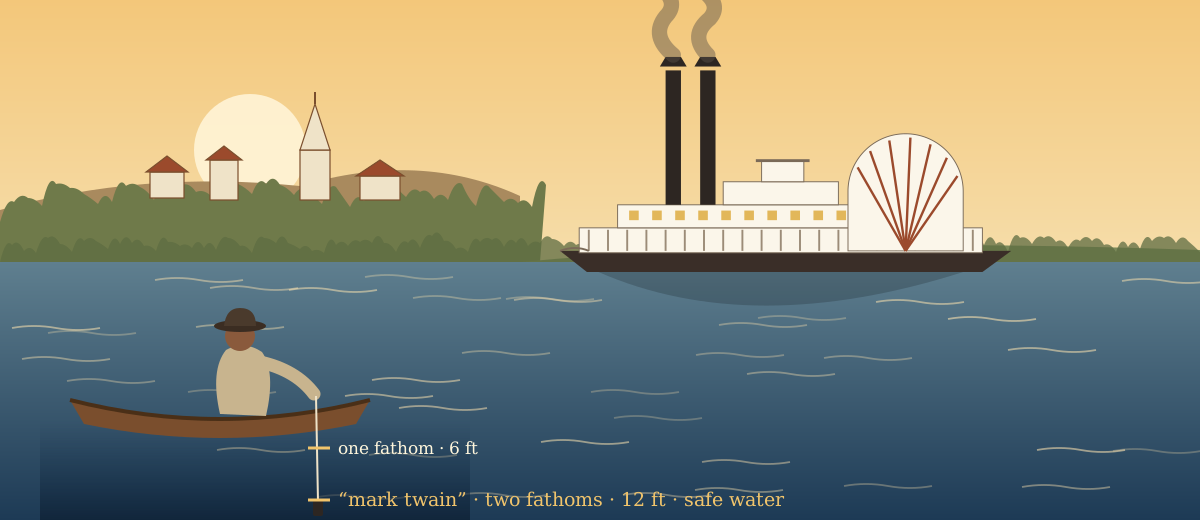
A steamboat needed enough water under its hull. A crewman called the leadsman dropped a weighted line and called out the depth. A fathom is six feet, and “twain” is an old word for two. “Mark twain” meant the line showed two fathoms, or 12 feet: safe water for a steamboat.
Clemens borrowed the call when he started signing his newspaper pieces in 1863. Think about it as you read: a name that means “safe water,” used by a writer who loved to stir up trouble.
How Twain’s Humor Works
The deadpan voice
Twain’s narrators tell outrageous things with a straight face. The reader gets the joke that the speaker misses.
The tall tale
Frontier storytelling, with jumping frogs and impossible boasts. Exaggeration delivered as plain fact.
Vernacular speech
He wrote people the way they talked, in regional dialects, and made that everyday speech a language for serious literature.
Satire
Under the laughs is a target: hypocrisy, greed, cruelty and slavery. The jokes are how he gets past the reader’s defenses.
Units

Novel · 1884–85
Adventures of Huckleberry Finn
Huck and Jim’s journey down the Mississippi: a 43-chapter guide, characters, a river map, themes, Twain’s dialects, an honest look at the book’s racial language, a river game and a quiz.
Coming soon
More Twain
More units on Twain’s stories and satire are on the way.
Sources and Credits
- Wikipedia, “Mark Twain” (birth, Hannibal, piloting and license, 1861, pen name and 1863 first use, Jumping Frog, marriage, death) and “Adventures of Huckleberry Finn” (publication dates).
- Art: the steamboat and raft illustrations and the preview image are original artwork made for Jugami.