Romeo and Juliet
Shakespeare’s tragedy of two young lovers in a city at war with itself, told act by act
Two teenagers meet at a party, fall in love at first sight, and get married the very next day. The trouble is that their families hate each other. Within four days, the city of Verona will be left counting the dead. William Shakespeare’s Romeo and Juliet is probably the most famous love story ever written, and it is also a fast, often funny play that turns heartbreaking when everyone starts rushing.
Shakespeare actually tells you how it ends in the very first speech, so the play isn’t really about whether things go wrong. It’s about how they go wrong, and whether anyone could have stopped it. Below you’ll find the story act by act and a guide to who’s who. After the themes and famous lines, there’s a short quiz to try.
📖 Want to read the whole play? The Folger Shakespeare Library has a free, easy-to-read online edition with act, scene and line numbers. You can also download it free from Project Gutenberg.
Shakespeare’s World
A little background goes a long way with this play.
When was it written?
Around 1595 to 1596, when Shakespeare (born 1564 in Stratford-upon-Avon) was about 31 and writing for an acting company called the Lord Chamberlain’s Men. It was first printed in 1597. That makes it one of his early plays, written around the same time as A Midsummer Night’s Dream.
Did he make it up?
Not exactly. The story of the doomed Italian lovers was already popular. Shakespeare’s main source was a long English poem by Arthur Brooke, The Tragicall Historye of Romeus and Juliet (1562). Shakespeare squeezed Brooke’s months-long story into about four days, which makes everything feel rushed and urgent.
Going to the theater
Plays were noisy, popular entertainment for everyone from apprentices to nobles. Performances happened in daylight with almost no scenery, so the words had to do the work of the set. Every part was played by a man or a boy, which means Juliet was played by a teenage boy.
Families and marriage
Wealthy parents usually arranged their children’s marriages for money and status, and daughters were expected to obey their fathers. That is why Lord Capulet’s fury in Act 3 would have felt shocking but real. Juliet is not yet 14; even in Shakespeare’s England, that was very young to marry.
Why Italy?
English audiences thought of Italy as glamorous and a little dangerous, a place where tempers ran hot and family honor was worth drawing a sword over. Setting the play in Verona (and Mantua, where Romeo is exiled) made the feud believable.
Plague was real
Deadly plague outbreaks shut London’s theaters for long stretches in the 1590s. Audiences would have understood exactly why, in Act 5, a messenger gets stuck in a quarantined house. Mercutio’s curse, “A plague o’ both your houses,” hit close to home.
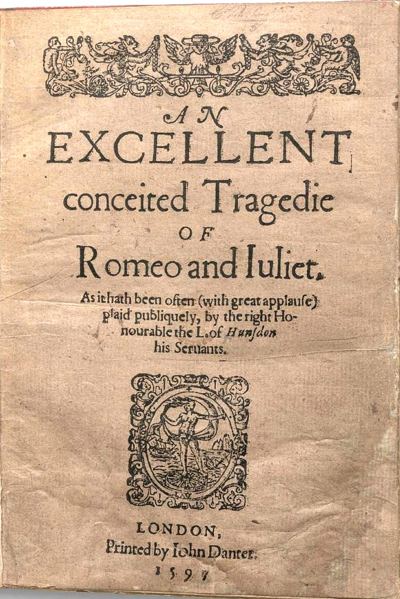
The first printing, 1597
This is the title page of the very first printed edition, called the First Quarto. Spelling was looser back then, so “Juliet” appears as “Iuliet,” and the play is sold as “An Excellent conceited Tragedie.” It also boasts that the play had been performed “often (with great applause)” by Lord Hunsdon’s servants, which was the name Shakespeare’s acting company went by for a short time around 1596–97.
Image: title page of Romeo and Juliet, First Quarto (London: John Danter, 1597). Public domain, via Wikimedia Commons (scan from Internet Shakespeare Editions).

Main Characters
Two households, “both alike in dignity,” plus a few people caught in the middle.
House of Montague
- Romeo
- Montague’s son. A teenager. The play never gives his age, though he’s usually played around 16 or 17. He falls hard and fast, and when we first meet him he’s moping over a girl named Rosaline.
- Benvolio
- Romeo’s cousin and friend. His name means “good will,” and he is always trying to keep the peace.
- Lord and Lady Montague
- Romeo’s parents. They worry about their son but don’t really know what’s going on with him.
- Balthasar
- Romeo’s loyal servant, who brings him the (wrong) news in Mantua.
House of Capulet
- Juliet
- The Capulets’ only daughter, almost 14. She starts out obedient but becomes the bravest, most clear-thinking person in the play.
- Tybalt
- Juliet’s hot-headed cousin, nicknamed the “Prince of Cats.” He lives for a fight and hates all Montagues.
- The Nurse
- Juliet’s nanny, who has looked after her since she was a baby. She talks too much, tells rude jokes, and helps the lovers until the moment she doesn’t.
- Lord and Lady Capulet
- Juliet’s parents. Lord Capulet seems kind at first, then explodes when Juliet refuses to marry Paris.
Mercutio
Romeo’s witty, wild best friend and a relative of the Prince, so he belongs to neither family. He gets the best jokes, including the famous “Queen Mab” speech.
Friar Laurence
A priest and herb expert who marries the lovers in secret, hoping it will end the feud. His clever plans keep backfiring.
Paris
A wealthy young nobleman, also the Prince’s relative, whom the Capulets want Juliet to marry.
Prince Escalus
Ruler of Verona. Fed up with the street fights, he declares that anyone who disturbs the peace again will pay with their life.
The Plot, Act by Act
The whole story takes about four days, from Sunday morning to early Thursday. Watch for the moments of dramatic irony, when we know something the characters don’t.
Act I
The Feud and the Party
A street brawl in the morning and love at first sight by nightfall
A Chorus opens the play with a sonnet that gives away the ending: two “star-crossed lovers” from feuding families will die, and only their deaths will end the hatred. Then the action starts with a bang. Servants of the Capulets and Montagues trade insults and start a sword fight in the streets of Verona. Benvolio tries to stop it; Tybalt makes it worse. Prince Escalus arrives, furious, and declares that the next person to break the peace will be put to death.
Meanwhile, Romeo is miserable because Rosaline doesn’t love him back. Across town, a nobleman named Paris asks Lord Capulet for permission to marry Juliet. Capulet says she’s too young, but tells Paris to woo her at the family’s feast that night. Romeo and his friends hear about the party and decide to sneak in wearing masks, mostly so Romeo can see Rosaline.
At the feast, Romeo spots Juliet and instantly forgets Rosaline. Tybalt recognizes Romeo’s voice and wants to fight him right there, but Lord Capulet orders him to back off. Romeo and Juliet speak for the first time; their first fourteen lines together form a perfect sonnet, ending in a kiss. Only afterward does each learn who the other is. “My only love sprung from my only hate!” Juliet gasps.
Act II
The Balcony and the Wedding
Secret vows by moonlight and a wedding the next afternoon
After the party, Romeo climbs the wall into the Capulets’ orchard. Juliet appears at her window (the famous “balcony scene”) and, thinking she’s alone, wishes Romeo weren’t a Montague. Romeo reveals himself. They confess their love, and Juliet, worried it is all “too rash, too unadvised, too sudden,” still asks: if you mean it, send word tomorrow about our wedding.
At dawn Romeo rushes to Friar Laurence. The friar teases him for forgetting Rosaline so fast, but agrees to marry the couple, hoping the match will turn the families’ “rancour to pure love.” His advice: “Wisely and slow. They stumble that run fast.”
Tybalt has sent a letter challenging Romeo to a duel. Mercutio mocks Tybalt and teases the Nurse when she comes to find Romeo. Romeo tells her the plan: Juliet should go to the friar’s cell that afternoon, pretending to go to confession. The Nurse drives Juliet crazy by delaying the news, then sends her off. Friar Laurence warns that “these violent delights have violent ends,” and leads the couple away to be married.
Act III
Two Deaths and a Banishment
The turning point, where comedy turns to tragedy
It is a hot afternoon, and “the mad blood” is stirring. Tybalt finds Romeo and calls him a villain. Romeo, secretly now Tybalt’s cousin by marriage, refuses to fight. Mercutio, disgusted by this “calm, dishonourable, vile submission,” draws his sword on Tybalt. Romeo steps between them, and Tybalt stabs Mercutio under Romeo’s arm. Dying, Mercutio still makes a pun (“ask for me tomorrow, and you shall find me a grave man”) and curses: “A plague o’ both your houses!”
Enraged, Romeo fights Tybalt and kills him, then cries, “O, I am fortune’s fool!” and flees. The Prince spares Romeo’s life because Tybalt killed first, but banishes him from Verona forever. Juliet, waiting eagerly for her wedding night, hears the news from the Nurse and is torn between grief for her cousin and loyalty to her husband. She chooses Romeo.
Hiding in Friar Laurence’s cell, Romeo says banishment is worse than death and even tries to stab himself. The friar scolds him and makes a plan: spend the night with Juliet, then escape to Mantua until things can be fixed. Meanwhile Lord Capulet, thinking a wedding will cheer Juliet up, promises her to Paris for Thursday. At dawn the lovers part (was that the lark or the nightingale?). When Juliet refuses to marry Paris, her father explodes and threatens to throw her out. Even the Nurse tells her to forget Romeo and marry Paris. Juliet now stands alone.
Act IV
The Friar’s Desperate Plan
A sleeping potion turns a wedding into a funeral
Juliet goes to Friar Laurence and finds Paris there, planning the wedding. After he leaves, she pulls out a knife and says she’d rather die than marry him. The friar offers a risky alternative: a potion that will make her look dead for “two and forty hours.” Her family will lay her in the Capulet tomb; he will send a letter telling Romeo to come, and when she wakes, Romeo can take her to Mantua.
Juliet goes home and pretends to agree to marry Paris. Overjoyed, her father moves the wedding up a day, to Wednesday. Alone that night, Juliet is terrified. She worries the potion might be poison, and she pictures waking up too early in the dark tomb beside Tybalt’s body. She drinks it anyway.
In the morning, the Nurse comes to wake the bride and finds her apparently dead. The household’s wedding music and feast turn into a funeral. Friar Laurence calmly organizes the burial, knowing the truth.
Act V
The Tomb
A letter goes astray, and the feud ends at a terrible price
In Mantua, Romeo’s servant Balthasar arrives with awful news: Juliet is dead and buried. Romeo never got the friar’s letter. He buys illegal poison from a poor Apothecary and heads for Verona. Back home, Friar Laurence learns that Friar John, his messenger, was locked inside a house quarantined for plague and couldn’t deliver the letter. Laurence rushes to the tomb.
At the Capulet tomb, Paris is laying flowers for Juliet. He sees Romeo, thinks he has come to vandalize it, and challenges him. They fight, and Romeo kills Paris. Inside, Romeo sees Juliet, still beautiful, says goodbye, drinks the poison, and dies: “Thus with a kiss I die.”
Moments later, the friar arrives and Juliet wakes up. Hearing the watchmen coming, he begs her to flee with him, then runs off alone. Juliet finds Romeo dead, kisses his lips hoping for leftover poison, and stabs herself with his dagger. The Prince and both families arrive. Lady Montague has died of grief over Romeo’s exile. Friar Laurence explains everything. Shattered, Capulet and Montague finally shake hands and promise golden statues of each other’s child. The Prince closes the play: “For never was a story of more woe / Than this of Juliet and her Romeo.”
Key Themes
These are the ideas Shakespeare keeps coming back to throughout the play.
Love, in many forms
The play shows love in several versions, from Romeo’s crush on Rosaline to Paris’s polite arranged match to the all-consuming love of Romeo and Juliet. Is theirs real and life-changing, or teenage infatuation? You can make a good case either way.
Hate and violence
Nobody ever explains what started the feud, and that seems deliberate. The hatred has become a habit handed down from parents to children, and in the end it destroys the children. Love and hate are tangled together, as in Romeo’s line “O brawling love, O loving hate.”
Fate versus free will
The Prologue calls the lovers “star-crossed,” doomed by the stars. But characters also make rash choices: fighting, rushing, lying. Was the ending destiny, or a chain of human mistakes?
Time and haste
Everything in this play happens too fast. They fall in love in one night and marry the next day, and later a letter arrives too late. Even the friar who warns “they stumble that run fast” ends up racing the clock.
Youth versus age
The young people act on feeling, while the adults mostly act on pride and rarely stop to listen. In the end, the parents learn their lesson only after losing their children.
Light and dark
Juliet is “the sun,” she teaches “the torches to burn bright,” and their love belongs to the night. Shakespeare’s imagery shows love as a brilliant flash: beautiful, and over too quickly, “like the lightning.”
Famous Quotes, in Plain English
You’ve probably heard some of these already. Here’s what they actually mean.
“Two households, both alike in dignity, / In fair Verona, where we lay our scene…”
Two equally important families in Verona. The Prologue is a 14-line sonnet, the classic love-poem form, which hints this will be a love story.
“A pair of star-crossed lovers take their life.”
Two lovers, doomed by the stars (fate), will die by suicide. The spoiler comes before Act 1 even starts!
“But soft, what light through yonder window breaks? / It is the east, and Juliet is the sun.”
“Wait, what’s that light in the window over there?” Romeo’s metaphor makes Juliet the sun, the center of his world.
“O Romeo, Romeo, wherefore art thou Romeo?”
Not “where are you?” but “why are you Romeo?” Wherefore means “why.” She’s wishing he were from any family but the Montagues.
“What’s in a name? That which we call a rose / By any other name would smell as sweet.”
A name is just a label. A rose would still smell sweet if we called it something else, and Romeo would still be perfect without the name “Montague.” The 1599 printing reads “by any other word”; the 1597 printing has “name,” the version most people quote.
“Good night, good night! Parting is such sweet sorrow / That I shall say good night till it be morrow.”
Saying goodbye hurts but is sweet too, so much that she could keep saying it until morning. “Sweet sorrow” is an oxymoron, two opposite ideas side by side.
“These violent delights have violent ends.”
Intense, sudden passions tend to end suddenly and badly. A big piece of foreshadowing.
“A plague o’ both your houses!”
“Curse both your families!” Mercutio dies because of a feud that wasn’t even his, and his curse seems to come true.
“O, I am fortune’s fool!”
“Fate is toying with me!” Right after killing Tybalt, Romeo blames luck, not his own temper.
“For never was a story of more woe / Than this of Juliet and her Romeo.”
There has never been a sadder story. The play ends with a rhyming couplet, like a sonnet.
Quotations use modern spelling. Line numbers can differ between editions.
Test Yourself
Ten quick questions to see how much stuck. Click an answer to check it.
The Verona Challenge
Talk About It
Questions to argue about in class or at home. None of them has one right answer.
- Who or what is most to blame for the deaths: fate, the feud, the parents, Friar Laurence, or Romeo and Juliet themselves? Rank them and defend your list.
- Shakespeare reveals the ending in the Prologue. Does knowing the ending make the play less exciting, or more? Why?
- Is Romeo and Juliet’s love real, or is it infatuation? Use what happened with Rosaline as evidence.
- The Nurse helps Juliet, then tells her to marry Paris. Is that betrayal, or practical advice from someone who cares about her?
- How would the story change if it were set today, with phones and texting? Which disasters would be avoided, and which wouldn’t?