

High School English · Mark Twain
Adventures of Huckleberry Finn
A runaway boy, a man escaping slavery, one raft, and about eleven hundred miles of river.
“You don’t know about me without you have read a book by the name of The Adventures of Tom Sawyer; but that ain’t no matter.” That is how the book begins: not in Mark Twain’s voice, but in the voice of a barely schooled teenage boy from a Missouri river town, who goes on to tell us that Mr. Mark Twain “told the truth, mainly.” From the first sentence, Twain hands the whole novel to Huck, and Huck never gives it back.
Adventures of Huckleberry Finn was first published in Britain in December 1884 and in the United States in February 1885. It is one of the funniest books in American literature and one of the most argued about. It is a comic adventure, a sharp satire of the white South before the Civil War, and the story of a boy who decides that his friendship with Jim, a man fleeing slavery, matters more than everything his society taught him to believe.
On this page: the story in brief, the people Huck meets, a guide to all 43 chapters, a map of the journey, the big themes, how Twain uses humor and dialect, an honest look at the book’s racial language, the history behind it, a river game, a quiz, and questions to argue about.
Before you read. Huck’s world is a slave-holding world, and the book shows it as it was. Characters, including Huck and Jim, use a racial slur for Black people more than 200 times. We do not repeat that word on this page; when it matters we call it “the slur.” The book also includes violence: a murder in the street, a family feud that kills a boy, and a father who beats his son. Talk with your teacher or a family member about anything that troubles you. Our section on the book’s language explains why many teachers still teach it, and why many readers object.
The Story in Brief
Huck Finn has money now. At the end of Tom Sawyer, he and Tom found a robbers’ treasure, and Judge Thatcher keeps Huck’s share in trust. The kindly Widow Douglas has taken Huck in to “sivilize” him, with help from her strict sister, Miss Watson. Huck finds clean clothes, school and prayers nearly unbearable.
Then his father returns. Pap is a violent drunk who wants Huck’s money. He kidnaps Huck to a cabin across the river and beats him. Huck escapes by faking his own murder and hides on Jackson’s Island, where he finds Jim, a man enslaved by Miss Watson. Jim has run away because he overheard that she was going to sell him down the river to New Orleans.
The two set off on a raft. Their plan is to reach Cairo, Illinois, where the Ohio River joins the Mississippi, sell the raft, and take a steamboat up the Ohio to the free states. In a thick fog they drift past Cairo without knowing it, and the current carries them deeper into the slave-holding South.
Along the way, Huck lands among a feuding family, the Grangerfords, and two con men who call themselves a duke and a king take over the raft. They swindle town after town, until the king sells Jim for forty dollars. Huck has to decide whether to report Jim to Miss Watson, as his upbringing tells him a good boy should, or to help him. He decides to help, even believing it will send him to hell.
Jim is being held at the Phelps farm, and the Phelpses turn out to be Tom Sawyer’s aunt and uncle. Tom arrives and turns the rescue into a long, absurd game copied from adventure books. In the escape Tom is shot in the leg, and Jim gives up his chance at freedom to help the doctor care for him. Then Tom reveals the secret he knew all along: Miss Watson had died two months before and freed Jim in her will. Jim also tells Huck that pap is dead. The book ends with Huck planning to “light out for the Territory” before Aunt Sally can civilize him.
Characters
Huck meets dozens of people. These are the ones to know.
On the raft
- Huckleberry Finn
- The narrator. In an 1895 notebook entry, Twain called him “a boy of 14” (Mark Twain Project). Poor, mostly unschooled, and suspicious of “sivilized” rules. A quick, practical liar when he has to be, and more honest with himself than almost anyone in the book.
- Jim
- A man enslaved by Miss Watson who runs away to avoid being sold away from his wife and children. Superstitious at first glance, but also caring, wise and brave. He hopes to buy his family’s freedom.
St. Petersburg
- Tom Sawyer
- Huck’s friend, hero of Twain’s earlier novel. Lives for adventure stories and insists on doing everything “by the books,” whatever the cost to others.
- Pap Finn
- Huck’s father. A drunk, a bully and a racist who hates that his son can read. He is the first thing Huck escapes.
- Widow Douglas
- Kind, patient and religious. She takes Huck in and tries to civilize him.
- Miss Watson
- The widow’s sister. Strict and pious, she legally owns Jim, and she plans to sell him for eight hundred dollars.
- Judge Thatcher
- Keeps Huck’s money safe from pap.
Down the river
- The Grangerfords
- A wealthy, polite, churchgoing family locked in a decades-old feud with the Shepherdsons. Buck Grangerford is about Huck’s age.
- The duke and the king
- Two con men who claim to be the lost Duke of Bridgewater and the rightful King of France. They rob, lie and cheat their way down the river.
- Colonel Sherburn
- Shoots a harmless drunk named Boggs in the street, then shames the mob that comes to lynch him.
- The Wilks sisters
- Mary Jane, Susan and Joanna, whose inheritance the king and duke try to steal. Mary Jane’s goodness moves Huck to act.
The Phelps farm
- Aunt Sally and Uncle Silas Phelps
- Tom’s aunt and uncle. Warm, kind and hospitable to Huck, and they also hold Jim locked up, waiting to claim a reward.
- Aunt Polly
- Tom’s aunt from St. Petersburg, who arrives at the end and sorts out who is who.
Chapter Guide
All 43 chapters, grouped by where Huck is. The summaries are our own; quotations come from the Project Gutenberg text of the first edition.
Part 1 · St. Petersburg
Chapters 1–7 · Missouri, on the river
- Chapter 1
Sivilizing Huck
Huck introduces himself, lives with the Widow Douglas, and endures Miss Watson’s lessons. At night Tom Sawyer signals him from outside.
Watch for: the voice. Huck is the narrator, and he doesn’t always see what we see. - Chapter 2
Tom Sawyer’s Gang
The boys sneak past Jim, and Tom plays a trick that Jim turns into a famous witch story. In a cave, Tom’s gang swears a bloody oath taken from robber books.
Watch for: how Tom’s games depend on books, not real life. - Chapter 3
Prayer and A-rabs
Prayer fails to produce fish-hooks. A drowned body is found and taken for pap. The gang “attacks” a Sunday-school picnic, and Huck decides Tom’s genies are lies.
Watch for: Huck testing what adults and Tom tell him. - Chapter 4
A Track in the Snow
Huck spots pap’s boot print and quickly signs his money over to Judge Thatcher. He asks Jim’s hair-ball to tell his future.
- Chapter 5
Pap Returns
Pap is furious that Huck can read and is putting on “frills.” A new judge tries to reform pap; he gets drunk and breaks his arm.
- Chapter 6
The Cabin
Pap kidnaps Huck to a cabin on the Illinois shore. Pap rants against the “govment” after seeing a free, educated Black man from Ohio who could vote. Pap’s delirium nearly turns deadly.
Watch for: Twain letting pap’s own words make him ridiculous. - Chapter 7
Huck’s “Murder”
Huck fakes his own killing with a wild pig’s blood and paddles to Jackson’s Island.
Part 2 · Jackson’s Island and the River
Chapters 8–16 · Huck finds Jim
- Chapter 8
Jim on the Island
Searchers fire a cannon and float bread to find Huck’s body. Huck finds Jim, who explains he ran because Miss Watson meant to sell him “down to Orleans.” Huck promises not to tell.
Watch for: Jim’s joke that he is rich because he owns himself and is “wuth eight hund’d dollars.” - Chapter 9
The House of Death
A flood brings a floating house. Inside lies a dead man, shot in the back. Jim covers the face and won’t let Huck look.
Watch for: remember this man. The last chapter explains him. - Chapter 10
The Snake-skin
Huck’s prank with a dead rattlesnake gets Jim bitten. Huck dresses as a girl to scout the town.
- Chapter 11
“They’re After Us!”
Mrs. Judith Loftus sees through Huck’s disguise and reveals that men are heading to the island to catch Jim for a $300 reward. Huck and Jim flee by raft.
- Chapter 12
The Walter Scott
They pass St. Louis. Huck insists on boarding a wrecked steamboat, where robbers are planning to kill one of their own.
- Chapter 13
Escape from the Wreck
Huck and Jim escape in the robbers’ skiff. Huck tries to send help for the stranded men, but the wreck sinks.
- Chapter 14
Was Solomon Wise?
Reading the stolen books, Huck tells Jim about kings. Jim argues with real logic about King Solomon and why a Frenchman doesn’t “talk like a man.”
Watch for: who actually wins these arguments. - Chapter 15
Fog and “Trash”
Separated in the fog, Huck convinces Jim it was all a dream. Jim’s answer shames him, and Huck apologizes.
Watch for: the first big turn in their friendship. - Chapter 16
Passing Cairo
Huck’s conscience torments him for helping Jim. He sets out to turn Jim in, then lies to slave hunters to protect him. Clear Ohio water shows they have missed Cairo, and a steamboat smashes the raft.
Part 3 · The Grangerfords
Chapters 17–18 · A feud
- Chapter 17
“George Jackson”
Huck, calling himself George Jackson, is taken in by the wealthy Grangerfords. He admires their parlor and the gloomy poems of their dead daughter, Emmeline.
Watch for: Emmeline’s poem about Stephen Dowling Bots. Twain is mocking sentimental verse. - Chapter 18
The Feud
The Grangerfords and Shepherdsons go to church with guns and listen to a sermon about brotherly love. Sophia Grangerford elopes with Harney Shepherdson, and the feud explodes. Buck is killed. Huck finds Jim and the mended raft.
Watch for: “there warn’t no home like a raft, after all.”
Part 4 · The King and the Duke
Chapters 19–31 · Con men take the raft
- Chapter 19
Royalty Comes Aboard
Peaceful days on the river end when two fleeing swindlers join the raft. One claims to be the Duke of Bridgewater; the other, the lost Dauphin of France.
- Chapter 20
Pokeville
The king “reforms” at a camp meeting and collects $87.75 for a fake mission to pirates. The duke prints a handbill describing Jim as a runaway so they can travel by day.
- Chapter 21
Bricksville
The duke rehearses a scrambled Hamlet speech. In a lazy Arkansas town, Colonel Sherburn shoots the drunk Boggs in front of a crowd.
- Chapter 22
Sherburn and the Mob
Sherburn faces down a lynch mob and calls them cowards. The con men’s Shakespeare show flops.
- Chapter 23
The Royal Nonesuch
A crude show swindles the town three nights running. That night Jim grieves for the time he struck his little daughter, ’Lizabeth, not knowing she had lost her hearing.
Watch for: Huck’s line that Jim “cared just as much for his people as white folks does for their’n.” - Chapter 24
The Wilks Scheme
The king learns that Peter Wilks has died and that his brothers Harvey and William are expected from England. The king and duke pose as the brothers.
- Chapter 25
Tears and Flapdoodle
The frauds weep over the coffin and give the girls the $6,000 in gold. Dr. Robinson calls them fakes; no one listens.
- Chapter 26
Huck Steals the Gold
Joanna questions Huck about England. Ashamed, Huck steals the gold back from the king to return it to the sisters.
- Chapter 27
The Coffin
Huck hides the money in Peter Wilks’s coffin. The king sells the family’s enslaved people, splitting mothers from children.
Watch for: the grief of the separated family, the cruelty Jim ran from. - Chapter 28
Huck Tells the Truth
Huck tells Mary Jane the truth and sends her away. The real brothers arrive.
- Chapter 29
The Tattoo
Handwriting and a tattoo test expose the frauds. The town digs up the coffin, finds the gold, and in the confusion Huck escapes.
- Chapter 30
Thieves Fall Out
The king and duke catch up and accuse each other of stealing the gold.
- Chapter 31
“All right, then, I’ll go to hell”
The king sells Jim for forty dollars. Huck writes to Miss Watson to tell her where Jim is, then remembers Jim’s kindness and tears the letter up.
Watch for: the moral climax of the book.
Part 5 · The Phelps Farm
Chapters 32–Last · Tom Sawyer returns
- Chapter 32
“Tom Sawyer”
Aunt Sally Phelps greets Huck warmly, believing he is her nephew Tom. Huck plays along.
- Chapter 33
Tar and Feathers
Tom arrives and poses as his brother Sid. He agrees to help free Jim. A mob tars and feathers the king and duke.
Watch for: Huck’s pity even for these crooks. - Chapters 34–35
Tom’s Rules
Tom works out where Jim is held. He refuses any simple escape and insists they dig with case-knives, as prisoners do in books.
- Chapters 36–37
Witch Pie
The boys dig a tunnel, steal spoons and sheets, and bake a rope ladder into a “witch pie” for Jim.
- Chapters 38–39
Coats of Arms and Rats
Jim must carve a coat of arms and live with rats, snakes and spiders. Tom sends anonymous letters warning of the escape.
Watch for: Jim suffering for a game. - Chapter 40
The Escape
Armed farmers chase them, and Tom is shot in the calf. Jim refuses to leave until a doctor comes.
- Chapter 41
The Doctor
Huck fetches a doctor and is caught by Uncle Silas. Aunt Sally worries all night.
- Chapter 42
Jim Was Free
Jim is brought back in chains. The doctor reports that Jim risked his freedom to help nurse Tom. Tom reveals that Miss Watson freed Jim in her will. Aunt Polly arrives.
- Chapter the Last
The Territory
Tom gives Jim forty dollars. Jim tells Huck the dead man in the floating house was pap. Huck plans to light out for the Territory.
The River Journey
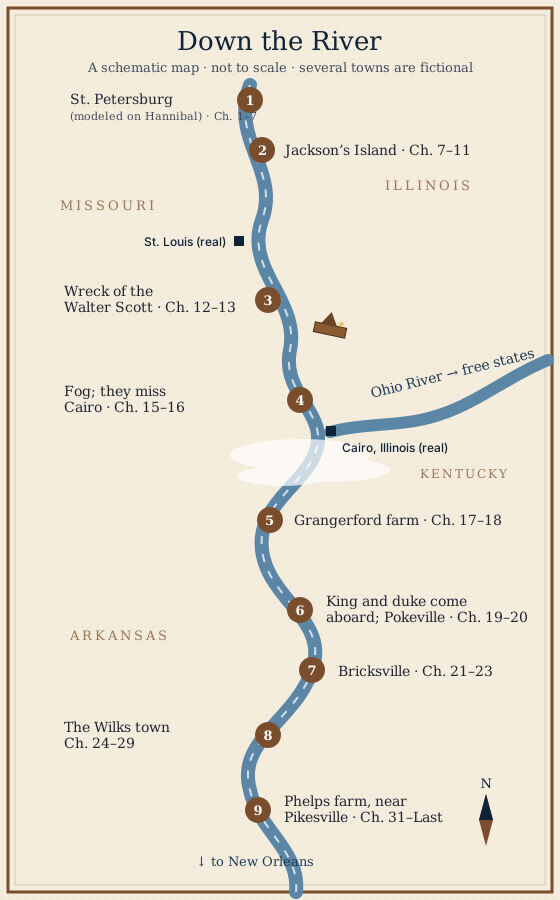
The Mississippi is the book’s main road. Huck and Jim drift south on a log raft, mostly at night, and hide in willows by day.
Going the wrong way. South is the wrong direction for freedom. Jim needed to get north. The plan was to reach Cairo and take a steamboat “way up the Ohio amongst the free States.” Once they miss Cairo in the fog, every mile carries Jim deeper into slave country. Readers have long argued about this: the river gives them peace, but the current keeps dragging Jim toward danger.
Raft and shore. On the raft, Huck and Jim make their own rules. Every time they go ashore they meet violence, greed or hypocrisy: the feud, the shooting in Bricksville, the cons, the slave auction. Huck says it best: “Other places do seem so cramped up and smothery, but a raft don’t.”
Map not to scale. St. Petersburg is Twain’s fictional version of Hannibal, Missouri. Pokeville, Bricksville and Pikesville are fictional; the book says Bricksville is “pretty well down the State of Arkansaw.”
Themes
Freedom
Huck runs from pap and from being “sivilized”; Jim runs from slavery. The book asks whether these are the same kind of escape. They aren’t. Huck can go home any time; Jim risks being sold or killed. When Jim says he is rich because he owns himself, the joke is also a protest: the law counts a man as worth eight hundred dollars.
Conscience vs. society
Huck’s “conscience” is really the voice of his society. It tells him that helping Jim is stealing and a sin. His heart says otherwise. Twain turns the usual moral on its head: Huck does right when he believes he is doing wrong. In an 1895 notebook entry, Twain described this as a chapter “where a sound heart & a deformed conscience come into collision & conscience suffers defeat.”
Satire of the South
Twain aims at respectable people. Churchgoing feuders bring guns to a sermon on brotherly love. A pious slaveholder sells a man. A town falls for frauds because, as the king says, “Hain’t we got all the fools in town on our side?” The comedy has a target: the ideas that let decent-seeming people accept cruelty.
Race and slavery
Slavery is the book’s background and its moral test. Nearly every white character, kind or cruel, takes it for granted. Jim is shown loving his family, reasoning about Solomon, and protecting Huck. At the same time, some scenes, especially the long rescue game, put Jim in the role of a comic, passive prisoner. Readers still argue about whether Twain criticizes racist stereotypes or repeats them. Often he seems to do both.
Lies, cons and performance
Almost everyone performs: Tom with his books, the king and duke with their fake titles, Huck with his false names. Huck’s lies usually protect people; the con men’s lies rob them. Twain makes us ask which kinds of deception are honest.
Growing up
Huck learns to see Jim as a person and to trust his own judgment. Yet the ending returns him to Tom’s games, and at the last minute he plans to run again. Has he changed, or has the world refused to change around him?
Twain’s Humor and Dialect
A warning that is a joke. Before the story starts, Twain posts a “Notice”: “Persons attempting to find a motive in this narrative will be prosecuted; persons attempting to find a moral in it will be banished; persons attempting to find a plot in it will be shot.” It’s funny, and it’s a dare. The book is full of motives and morals.
The straight-faced narrator. Huck tells shocking things in a flat, matter-of-fact voice and often misses the point himself. Twain gets much of his comedy and satire from this gap between what Huck reports and what readers understand. When Huck admires Emmeline Grangerford’s dreadful poetry, the joke is on the poems, not on Huck.
Burlesque. The duke’s Shakespeare scrambles lines from Hamlet and Macbeth. Tom’s rescue spoofs adventure novels. Even the wreck where Huck nearly dies is named for Sir Walter Scott, the author of romantic tales of knights and chivalry.
Dialect. Twain insisted that every voice was deliberate. His “Explanatory” note lists “the Missouri negro dialect; the extremest form of the backwoods Southwestern dialect; the ordinary ‘Pike County’ dialect; and four modified varieties of this last.” He wrote them carefully so that readers would not “suppose that all these characters were trying to talk alike and not succeeding.” That was new. Huck’s plain spoken English, used as the language of a serious novel, helped change American writing; Ernest Hemingway later claimed that “All modern American literature comes from” this book.
A harder question. Jim’s speech is spelled out heavily, while the con men and many white characters get lighter treatment. Some readers hear respect for real speech; others see echoes of the minstrel stage, where white performers mocked Black speech for laughs. Reading Jim’s lines aloud in class can be uncomfortable for these reasons, and many teachers choose not to.
The Book’s Racial Language
The slur appears constantly in the novel, from Huck, from Jim, and from narrator and villains alike. In the 1830s–40s Mississippi Valley Twain was describing, white people used it casually. It was a word that denied Black people’s full humanity, and it was cruel then, too. Twain, writing in the 1880s, put it in the mouths of characters who would really have used it.
Why it hurts. The word has a long history of violence behind it. Seeing it hundreds of times, or hearing classmates read it aloud, can wound Black students in particular, whatever the author meant. That is a real cost, and many schools take it seriously.
Why many teachers keep the book. The language shows how ordinary racism was, even among “good” people like the Widow Douglas and Aunt Sally. When Huck reports a steamboat accident in Chapter 32 and says no one was hurt, only a Black man killed, Aunt Sally answers, “Well, it’s lucky,” and Twain lets that moment indict a whole society. Huck’s decision in Chapter 31 matters because he has absorbed his world’s values completely.
Banned, challenged, changed. The book has been fought over since it appeared. In 1885 the public library in Concord, Massachusetts, excluded it as “rough, coarse, and inelegant.” Later critics objected to its racism and racial language, and the American Library Association lists it among the most challenged books of the 1990s. In 2011 NewSouth Books published an edition, introduced by the Twain scholar Alan Gribben, that replaced the slur with “slave.” Some welcomed it; many scholars objected that it changed what Twain wrote.
How to read it well. Most classes agree on a few ground rules: don’t say the slur aloud, even when quoting; talk about who is speaking and why; notice where the book challenges racism and where it falls short; and listen to classmates whose experience of the word differs from yours.
Jim’s story, retold. In 2024 Percival Everett published James, which retells the story from Jim’s point of view. It won the 2024 National Book Award for Fiction and the 2025 Pulitzer Prize for Fiction, and it is a strong companion for older students who want to see what Twain’s version leaves out.
Historical Context
When it is set
Twain’s front page reads: “Scene: The Mississippi Valley. Time: Forty to fifty years ago.” Counting back from 1884, that means the 1830s and 1840s, decades before the Civil War. Missouri was a slave state; Illinois, across the river, was free.
When it was written
Twain wrote the novel by hand between 1876 and 1883, setting it aside for long stretches. It came out in Britain and Canada on December 10, 1884, and in the United States on February 18, 1885, with illustrations by E. W. Kemble.
Two eras at once
Slavery had been abolished for about twenty years when the book appeared, but Reconstruction had ended in 1877, and white Southern governments were rolling back the rights Black citizens had won. A story about a free man held in chains by people who “meant well” spoke to Twain’s present as well as his past.
Twain’s own river
Samuel Clemens grew up in Hannibal, Missouri, the model for St. Petersburg, and later became a licensed steamboat pilot. His pen name comes from the leadsman’s call “mark twain,” two fathoms (12 feet) of water, safe for a steamboat. More on Twain’s life.
Key Passages
Quoted exactly from the Project Gutenberg text of the first edition, dialect spellings and all.
“Dat truck dah is trash; en trash is what people is dat puts dirt on de head er dey fren’s en makes ’em ashamed.”
Why it matters: Jim calls Huck’s trick what it is, and claims the right to friendship and respect. Huck apologizes, and promises himself: “I didn’t do him no more mean tricks, and I wouldn’t done that one if I’d a knowed it would make him feel that way.”
“It’s lovely to live on a raft. We had the sky up there, all speckled with stars, and we used to lay on our backs and look up at them, and discuss about whether they was made or only just happened.”
Why it matters: The raft is the one place where Huck and Jim can talk as equals. Huck, who can barely spell, is a real poet of the river.
“I was a-trembling, because I’d got to decide, forever, betwixt two things, and I knowed it.” … “All right, then, I’ll go to hell”—and tore it up.
Why it matters: Huck has been taught that helping Jim is a sin. He chooses Jim anyway, believing he is damning himself. Twain makes the reader see what Huck can’t: the sin is slavery.
“Human beings can be awful cruel to one another.”
Why it matters: Huck feels pity even for the men who sold Jim. The line could stand as a summary of everything he has seen on shore.
“But I reckon I got to light out for the Territory ahead of the rest, because Aunt Sally she’s going to adopt me and sivilize me, and I can’t stand it. I been there before.”
Why it matters: Huck refuses to settle into the society he has seen. Is this freedom, or just running away again?
Down the River: Put the Stops in Order
Down the River
The nine stops below are scrambled. Use the ▲ and ▼ buttons (or Tab to a button and press Enter) to put them in the order Huck reaches them, top to bottom. Then press Check my route. Each stop is then marked ✓ Right place or ✗ Not yet.
Quiz
The Raft Quiz
Choose one answer per question. You’ll see right away whether you’re right, with a short explanation. Your score appears at the end.
Discussion Questions
For class or for your own journal. Back up your view with evidence from the text.
- Huck believes that helping Jim is wrong, and does it anyway. What does the book suggest about the difference between conscience and what a society teaches?
- Compare Huck’s and Jim’s reasons for running away. Why is Jim’s freedom so much riskier than Huck’s?
- Many readers, including Hemingway, disliked the Phelps farm chapters. Ralph Ellison argued they were morally necessary. Does Tom’s game ruin the ending, or reveal something important about Tom, about Huck, and about society?
- Where does the book show Jim as a full human being? Where does it fall back on stereotypes? Use at least two specific scenes.
- Choose one “shore” episode: the Grangerfords, Bricksville, or the Wilks family. What is Twain satirizing, and how does the raft compare?
- Should schools teach the book with its original language, with an edited text, or not at all? What would a fair class discussion of the slur look like?
- Tom knew Jim was free the whole time. What does that tell you about Tom? Why might Twain hold that fact back until Chapter 42?
- At the end Huck plans to “light out for the Territory.” Has he grown up, or is he running from the same problems?
Sources and Credits
- Mark Twain, Adventures of Huckleberry Finn, Project Gutenberg eBook #76 (gutenberg.org/ebooks/76), the text of the first edition with E. W. Kemble’s illustrations. All quotations on this page come from this text. Chapter summaries are our own paraphrases.
- Wikipedia, “Adventures of Huckleberry Finn” (publication dates, composition 1876–1883, reception, Concord library, ALA challenges, 2011 NewSouth edition, Hemingway and Ellison).
- Wikipedia, “Mark Twain” (Hannibal, piloting, pen name).
- Mark Twain Project, Huckleberry Finn, Appendix F (Twain’s 1895 notebook entry on “a sound heart & a deformed conscience” and Huck as “a boy of 14”).
- National Book Foundation, “James,” and The Pulitzer Prizes, “Percival Everett.”
- Art: the raft illustration, the river map and the preview image are original artwork made for Jugami. They are not Kemble’s illustrations.