
High School English · Mark Twain · Unit 4
Life on the Mississippi and Travel Writing
A cub pilot learning a river by heart, a shipload of pilgrims in Europe, and a stagecoach ride to the silver mines.
Before he was famous for novels, Mark Twain was famous for travel books. He wrote about places he had really been: the Mississippi, where he trained as a steamboat pilot; Europe and the Holy Land, which he toured by ship in 1867; and the American West, where he went looking for silver and found a career as a writer.
These books are true stories, mostly. Twain bends facts for a laugh, and part of reading him well is learning to tell when he is doing it. This unit covers three books: The Innocents Abroad (1869), Roughing It (1872) and Life on the Mississippi (1883).
On this page: travel writing as a genre, a guide to each book (context, summary, highlights and humor techniques), exaggeration versus fact, a note on period attitudes, key passages, a passage-matching game, a quiz, and questions that connect the books.
Before you read. These books were written between 1869 and 1883 and share many attitudes of their time. The Innocents Abroad often looks down on the people of the countries it visits. Roughing It describes Native Americans with open contempt, and its chapter on Chinese immigrants mixes real sympathy with outdated terms. Life on the Mississippi mentions enslaved and Black workers in the language of its era. Our section on period attitudes looks at these closely.
Travel Writing as a Genre
Travel writing is nonfiction about a journey: where the writer went, what they saw, and what it meant to them. In the nineteenth century, when few people could travel far, travel books and newspaper letters were how most readers saw the world. Many were serious and admiring. Twain’s were funny, and they often made fun of the traveler as much as the place.
Two of these books began as paid newspaper work. Twain’s place on the 1867 voyage was funded by the San Francisco Alta California in exchange for letters about the trip, and he later reshaped those letters into The Innocents Abroad. In Roughing It he describes being sent to the Sandwich Islands (Hawaii) to “write some letters for the Sacramento Union.”
The innocent narrator
Twain often plays a naive version of himself: young, ignorant and easily impressed, or easily fooled. The older writer looks back and laughs at the younger traveler.
Deflation
He builds up a famous sight or a romantic idea, then lets the air out of it with a plain fact or a flat comment. The grand “Pleasure Excursion” turns out to be more like a funeral.
Exaggeration
The tall tale, carried into nonfiction: a dust storm “about the size of the United States,” a coyote so hungry that even his fleas might leave him.
Irony
Saying one thing and meaning another. When the Americans call foreigners ignorant, the joke is on the Americans.
Vivid detail
Under the jokes, Twain is a sharp observer. His descriptions of the river, the stagecoach and the desert are still read as history.
Digression
He wanders: into history, statistics, stories he heard from others, and anecdotes that have nothing to do with the route. The wandering is part of the fun.
Life on the Mississippi
Memoir and travel book · 1883 · Read it free at Project Gutenberg
Context. Samuel Clemens grew up in Hannibal, Missouri, on the Mississippi, and in 1857 he became a “cub” (apprentice) pilot under Horace Bixby, who agreed to teach him the river for five hundred dollars. The chapters about learning the river were first printed as a series called “Old Times on the Mississippi” in The Atlantic Monthly in 1875. In the spring of 1882 Twain went back to the river to gather material for the rest of the book, and the finished Life on the Mississippi was published in 1883, in the United States and Britain at the same time.
Summary. The book opens with the river itself and its history. Then Twain turns to his boyhood: “there was but one permanent ambition among my comrades” in his village. “That was, to be a steamboatman.” The day comes alive only when a boat arrives and someone shouts “S-t-e-a-m-boat a-comin’!”
The young narrator becomes a “cub” pilot under Mr. Bixby, and the long middle section tells how he learned the trade. He sets out to learn “twelve or thirteen hundred miles of the great Mississippi River,” then discovers he must learn it “both ways,” by day and by night, and that the channel keeps shifting. The last part of the book jumps ahead: “after twenty-one years’ absence,” an older Twain travels the river again, down to New Orleans and up to the upper river, and finds the steamboat age fading.
Highlights
- Learning the river from Bixby. Bixby tells him: “There’s only one way to be a pilot, and that is to get this entire river by heart. You have to know it just like A B C.” The cub’s reaction: “my memory was never loaded with anything but blank cartridges.”
- The two ways of seeing the river. Once, a sunset over the river was pure beauty: “A broad expanse of the river was turned to blood.” After training, he reads the same scene as data: “This sun means that we are going to have wind to-morrow.” He has gained a skill, “But I had lost something, too.”
- The leadsmen’s call. Crewmen measuring the depth sing out “M-a-r-k twain!” A footnote explains it means “Two fathoms,” or twelve feet: safe water. Clemens later took the call as his pen name.
Humor techniques
- The innocent narrator: told how much there is to learn, the cub decides that “doubtless Mr. Bixby was ‘stretching.’” He wasn’t.
- Exaggeration in dialogue: Bixby, losing patience, vows “I’ll learn him or kill him.” A footnote adds, “‘Teach’ is not in the river vocabulary.”
- Deflation: the romantic river becomes a set of warnings. “All the grace, the beauty, the poetry had gone out of the majestic river!”
- Surprising comparison: he ends the sunset passage by thinking of doctors, who must see illness in a beautiful face: “Since those days, I have pitied doctors from my heart.”
Discussion questions
- Twain calls the river’s surface “a wonderful book.” What does it mean to read a river? What have you learned to “read” that other people can’t?
- Is the cub’s loss worth the gain? Think of something you understand better now but enjoy less.
- Why would Clemens choose a leadsman’s depth call as his name as a writer?
The Innocents Abroad
Travel book · 1869 · subtitled The New Pilgrims’ Progress · Read it free at Project Gutenberg
Context. In June 1867 the chartered steamship Quaker City left New York on a pleasure cruise to Europe and the Holy Land. Twain went along as a correspondent, sending letters to the Alta California, and the ship was back in New York in November. He rewrote the letters, toning down slang for a national audience, and the book was published in 1869. It became the best-selling of his books during his lifetime.
Summary. The book follows the voyage stop by stop: the Azores, Gibraltar and Tangier, France, Italy, Greece, Constantinople and the Black Sea, then the Holy Land and Egypt. Twain sorts his shipmates into the solemn “pilgrims” and the less pious “sinners.” He is honest about what disappointed him and sharp about tourists who pretend to love everything. He mocks guides, souvenir-hunters, old paintings, and above all his fellow Americans.
Highlights
- The innocent pilgrims. The cruise was advertised as “The Grand Holy Land Pleasure Excursion,” but Twain decides that “was a misnomer. ‘The Grand Holy Land Funeral Procession’ would have been better—much better.”
- Americans in Paris. “In Paris they just simply opened their eyes and stared when we spoke to them in French! We never did succeed in making those idiots understand their own language.”
- The guides. The travelers torment their guides by playing dumb. In Genoa a guide proudly shows them a letter in Columbus’s own hand, and the doctor calls it “the worst writing I ever saw.” Shown a bust of Columbus, he asks with a straight face: “pleasant name—is—is he dead?”
Humor techniques
- Irony: “The people of those foreign countries are very, very ignorant.” Read on: in Paris people “stared when we spoke to them in French,” and the tourists blame the French.
- Deflation: famous places and old masters are described in flat, plain terms instead of awe.
- Mock-seriousness: the travelers want to learn “all the curious, outlandish ways of all the different countries, so that we can ‘show off’” at home.
- A serious turn: near the end he writes, “Travel is fatal to prejudice, bigotry and narrow-mindedness.”
Discussion questions
- The title calls the travelers “innocents.” Innocent of what? Is it praise or mockery?
- Who is the target in the Paris joke: the French or the Americans? How can you tell?
- Does the book itself live up to “Travel is fatal to prejudice”? Use the section on period attitudes below.
Roughing It
Travel memoir · 1872 · Read it free at Project Gutenberg
Context. Roughing It was written in 1870–71 and published in 1872, after The Innocents Abroad. It covers Twain’s years in the West, 1861 to 1867. It begins: “My brother had just been appointed Secretary of Nevada Territory.” The narrator goes along, and admits, “I was young and ignorant, and I envied my brother.”
Summary. The brothers cross the plains by overland stagecoach, since “There was no Pacific railroad in those fine times.” They see the Pony Express, visit Salt Lake City, and reach Carson City, Nevada. The narrator catches silver fever, tries prospecting and mining, and is briefly a millionaire on paper before losing it through carelessness. He becomes a newspaper reporter in Virginia City, drifts to San Francisco, and finally sails to the Sandwich Islands (Hawaii) as a correspondent. Near the end he gives his first public lecture, and then heads home.
Highlights
- The stagecoach. “Our coach was a great swinging and swaying stage, of the most sumptuous description—an imposing cradle on wheels. It was drawn by six handsome horses.” Looking back: “It was fascinating—that old overland stagecoaching.”
- The coyote. “The cayote is a long, slim, sick and sorry-looking skeleton, with a gray wolf-skin stretched over it.” He is “a living, breathing allegory of Want,” so poor that “even the fleas would desert him for a velocipede.” (Twain spells it “cayote.”)
- The Washoe Zephyr. In Carson City, the summer afternoon wind arrives with “a soaring dust-drift about the size of the United States set up edgewise,” and the town disappears from view.
Humor techniques
- The innocent narrator: the greenhorn who expects adventure and gets dust, debt and fleas.
- Exaggeration: the Washoe wind carries off hats, chickens and parasols, and “blows flimsy houses down.”
- Mock-learned tone: a “zephyr” is a gentle breeze in poetry. Calling a dust storm a zephyr is the joke.
- Personification: the coyote is a character with a sad history, not just an animal.
Discussion questions
- Why is the narrator’s envy of his brother a good way to start a travel book?
- How does the coyote description work: what is accurate, and what is pure invention?
- Compare the West in Roughing It with the West in movies you know. What is missing from each?
Exaggeration Versus Fact
Travel books promise the truth, and Twain mostly delivers it: real routes, real dates, real people like Horace Bixby. But he also tells tall tales, invents dialogue, and stretches events to make them funnier. He even jokes about it. The preface to Roughing It says, “This book is merely a personal narrative, and not a pretentious history or a philosophical dissertation,” then apologizes that “information appears to stew out of me naturally, like the precious ottar of roses out of the otter.”
How can you tell when he is stretching? Use these tests:
- Size. A dust storm can be huge; one “the size of the United States” cannot. When the numbers get too big, he is joking.
- Checkable facts. Dates, places and depths (“mark twain” is two fathoms) can be checked, and usually hold up.
- Dialogue. Long, perfectly timed speeches remembered years later were probably polished, or invented.
- The narrator’s age. The young narrator is often more foolish than Twain probably was, because a fool is funnier.
Ask yourself: does exaggeration make a travel book less honest, or can it tell a truth about how a place felt?
Period Attitudes
Twain’s travel books show the prejudices of white Americans in his time, sometimes mocked and sometimes shared. Reading them well means noticing both.
- Condescension in The Innocents Abroad. Twain laughs at American tourists, but he also looks down on the people they visit. In the Holy Land he describes the village of Magdala as “thoroughly Syrian, and that is to say that it is thoroughly ugly.” Ask: when is he mocking the ignorant tourist, and when is he being one?
- Native Americans in Roughing It. The book describes the Goshute people with open contempt, calling them “the wretchedest type of mankind I have ever seen,” and judges a whole people from a brief meeting by the stage road. (Twain spells the name “Goshoot.”) The chapter goes on in the same way, and we have not reprinted more. Discuss: what does this passage show about the narrator, rather than about the Goshutes?
- Chinese immigrants in Roughing It. In Virginia City, Twain writes with real sympathy: “They are quiet, peaceable, tractable, free from drunkenness, and they are as industrious as the day is long.” He condemns their unequal treatment in court: “Any white man can swear a Chinaman’s life away in the courts, but no Chinaman can testify against a white man.” Yet the chapter also uses “Chinaman,” a term now considered offensive, and treats Chinese customs as curiosities. It is sympathetic and stereotyped at the same time.
- Slavery and race on the river. Life on the Mississippi remembers the river before the Civil War, when Missouri was a slave state. The shout “S-t-e-a-m-boat a-comin’!” comes from a Black dray driver, described in the language of 1883. Notice how rarely the book stops to think about these workers.
Twain wrote that travel is fatal to prejudice. These books suggest it takes more than one trip.
Twain’s views also changed later in life. He first spoke in favor of American interests in Hawaii but later reversed his position, and around 1900 he became an outspoken anti-imperialist: he served as a vice president of the American Anti-Imperialist League from 1901 until his death in 1910, and in 1901 published To the Person Sitting in Darkness, criticizing imperialism in China, South Africa and the Philippines (source: Wikipedia, “Mark Twain”).
Key Passages
“The face of the water, in time, became a wonderful book.”
The pilot learns to read the river the way you read a page.
“The romance and the beauty were all gone from the river.”
Ask yourself: is expert knowledge always a loss of wonder?
“Travel is fatal to prejudice, bigotry and narrow-mindedness, and many of our people need it sorely on these accounts.”
Notice: “our people” means Americans. The criticism points home.
“We never did succeed in making those idiots understand their own language.”
The joke: the speaker is the idiot, and doesn’t know it.
“The cayote is a living, breathing allegory of Want. He is always hungry.”
A mock-solemn phrase, “allegory of Want,” for a skinny desert dog.
“It was fascinating—that old overland stagecoaching.”
Why it matters: “There was no Pacific railroad in those fine times.” By the time he wrote this, there was. The book is already nostalgic.
Which Book?
Match the Passage to the Book
Nine moments from the three books. For each one, choose the book it comes from: Life on the Mississippi, The Innocents Abroad or Roughing It. A right pick is marked ✓ Right; a wrong pick is marked ✗ Try again, and you can choose again. Your score counts first tries.
Quiz
The Mark Twain Travel Quiz
Choose one answer per question. Your pick is marked ✓ if it is right or ✗ if it is not, the right answer is marked ✓, and a short explanation follows. Your score appears at the end.
Connecting the Books
For class or for your own journal. Back up your view with evidence from at least two books.
- In all three books the narrator starts out young and ignorant. Why is that such a useful narrator for travel writing?
- Twain goes abroad in one book and stays in America in the other two. Is he kinder to Americans or to foreigners? Find evidence.
- Each book records a world that was disappearing: the steamboat, the stagecoach, the old ideas of Europe. Is travel writing a kind of history?
- Choose one exaggeration from this page and rewrite it as a plain fact. What is lost, and what is gained?
- How would Twain write a review of a modern tourist spot? Write 200 words in his voice, with one exaggeration and one deflation.
- Twain says travel is fatal to prejudice. Using the period attitudes section, argue for or against the idea that his own books prove it.
Sources and Credits
- Mark Twain, Life on the Mississippi, Project Gutenberg eBook #245 (gutenberg.org/ebooks/245).
- Mark Twain, The Innocents Abroad, Project Gutenberg eBook #3176 (gutenberg.org/ebooks/3176).
- Mark Twain, Roughing It, Project Gutenberg eBook #3177 (gutenberg.org/ebooks/3177).
- Wikipedia, “Life on the Mississippi” (published 1883 in the U.S. and Britain), “Old Times on the Mississippi” (serialized in The Atlantic Monthly, 1875), “Horace E. Bixby” (met Twain in February 1857; Twain’s return to the river in spring 1882), “The Innocents Abroad” (the 1867 Quaker City voyage, the Alta California letters, the 1869 book and its sales), “Roughing It” (written 1870–71, published 1872, covering 1861–1867) and “Mark Twain” (his later reversal on Hawaii, his years as a vice president of the American Anti-Imperialist League, 1901–1910, and To the Person Sitting in Darkness, 1901).
- Summaries are our own paraphrases. Every quotation on this page was checked against the Project Gutenberg texts above.
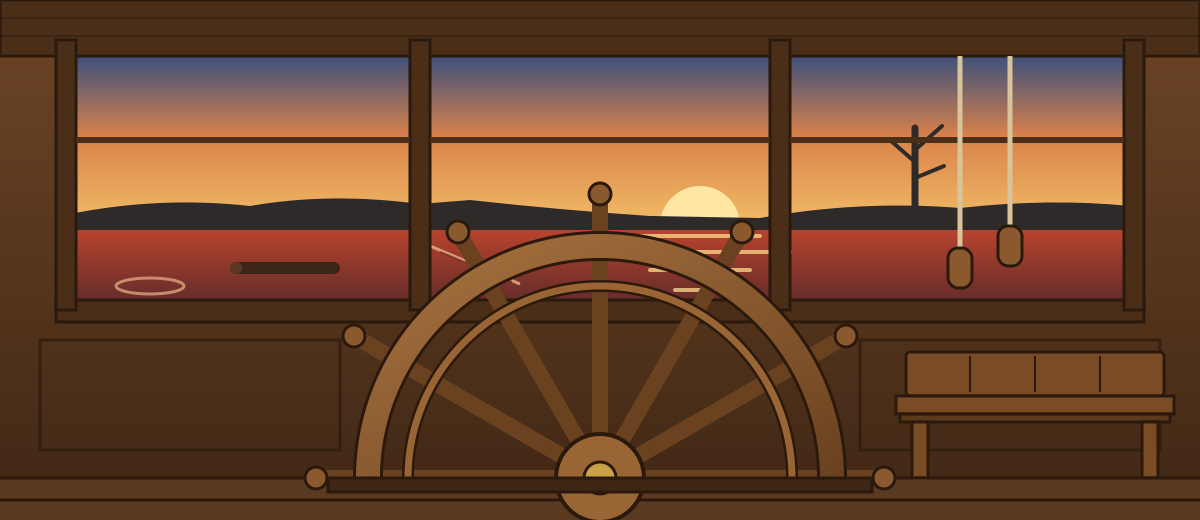
- Art: the pilot-house illustration and the preview image are original artwork made for Jugami.