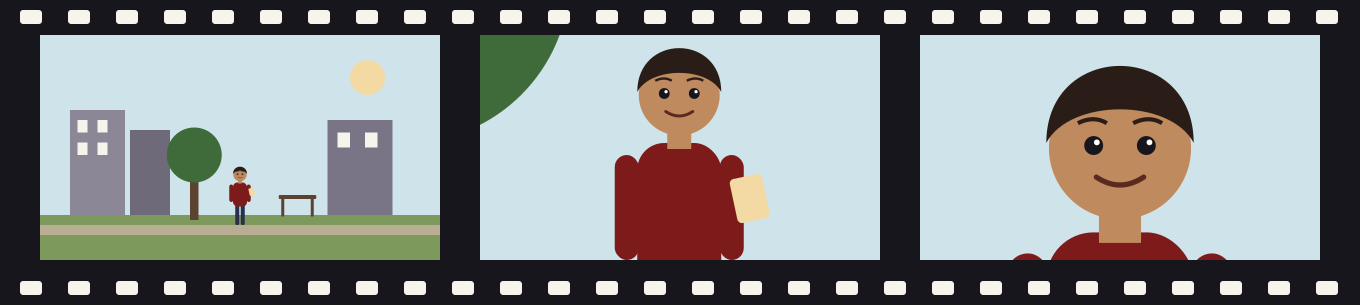
Every movie, video and clip you watch is built out of choices. Where does the camera stand? How close is it? When does it cut? Learn to see those choices, and then make your own.
One moment, three framings. Each one tells you to notice something different.
You watch video all the time: movies, shows, ads and short clips. Film and media literacy means knowing how those images work on you. A shot is one unbroken piece of recording. Directors and editors put shots in order to make you feel suspense, laughter or surprise.
In this course you will learn the words filmmakers use, practice spotting them in scenes you choose, and plan short sequences of your own on paper or with any camera you have. Sound is part of the language too: dialogue, sound effects, music and even silence can change how a scene feels. No fancy gear is required.
Shot sizes from extreme long shot to extreme close-up, camera angles, camera movement, and how editors join shots into a sequence with tools like shot/reverse shot and the eyeline match. Includes a frame explorer, a storyboard challenge and a nine-question self-guided quiz.
Dialogue, sound effects and Foley, music, diegetic and non-diegetic sound, and how silence shapes mood. Includes a soundtrack explorer, a Foley challenge and a nine-question self-guided quiz. No copyrighted clips are embedded.
More units coming. This course has two complete units so far, not a full curriculum.
Meet Alice, your teacher character
Alice is an AI teacher character inspired by Alice Guy-Blaché (1873–1968), a French filmmaker the Library of Congress calls world cinema’s first woman director. She began working for Léon Gaumont as a secretary in 1894 and made her first film in 1896. After moving to the United States in 1907, she was president of the Solax film company, which worked first in Flushing, New York, and then in Fort Lee, New Jersey.
Today the Library of Congress holds the largest collection of her Solax films, so researchers can still study how she told her stories on screen.
Our Alice borrows her curiosity and her love of a well-told story. She does not speak for the real Alice Guy-Blaché, and the lessons teach today’s film vocabulary, which grew over many decades and many filmmakers.
What you will practice
Name shot sizes and explain what each one asks you to notice.
Describe camera angles and movements, and question what they suggest.
Explain how editing joins shots into a sequence the audience can follow.
Break down a short scene shot by shot, with evidence.
Plan your own short sequence with a storyboard.
Tell diegetic sound from non-diegetic sound, and explain how dialogue, effects, music and silence shape mood.
Sources
Film terms are explained in our own words from BBC Bitesize, Central Connecticut State University, a Yale National Initiative curriculum unit, ACMI and the Library of Congress. Facts about Alice Guy-Blaché are checked against the Library of Congress and Columbia University.
Colophon: every drawing on this page (the park scene, the film strip, the camera-angle diagram and the share image) is original art made for Jugami. No third-party images, fonts or scripts are loaded. No quotations from Alice Guy-Blaché are used, and the teacher character’s tips are modern classroom advice, not historical statements.