
Unit 1 · Film and Media · Grades 6–8
How a Shot Tells a Story
Before a single line of dialogue, the camera is already talking. How far away it stands, where it looks from, and when the film cuts all tell you what to notice and how to feel.
What is a shot?
A shot is one unbroken stretch of recording. It starts when the camera starts rolling and ends at a cut, the point where the film switches to a different shot. A shot might last two seconds or several minutes.
Shots are the building blocks of everything you watch: movies, TV, ads, music videos and the clips on your phone. When shots are joined in order to show one stretch of action, we call that a sequence.
For every shot, a filmmaker makes three big choices you can learn to spot:
- Size: how much of the person or place fills the frame.
- Angle: where the camera looks from: above, level or below.
- Movement: whether the camera stays still, turns or travels.
The shot-size ladder
The simplest way to change a shot is to move the camera closer or farther away. Filmmakers name the sizes, usually by how much of a person you see.
- Extreme long shot: a big place, like a landscape, building or crowd. People are tiny or hard to recognize.
- Long shot (also called a wide shot): the whole person, head to toe, with their surroundings. It shows what they are doing and where.
- Medium shot: about waist up. You see the face and body language together.
- Close-up: a face, or an object of similar size, fills the frame. Small expressions become big news.
- Extreme close-up: just part of a face, like the eyes, or a small detail like a key. It shouts “this matters.”
When the first shot of a scene shows the whole place, it is often called an establishing shot. It tells you where you are before the story moves in closer.
Frame explorer
Press a button to reframe the same drawing. Nothing in the scene changes, only how close the “camera” is.
| Shot size | Frame | What it asks you to notice |
|---|---|---|
| Extreme long shot | 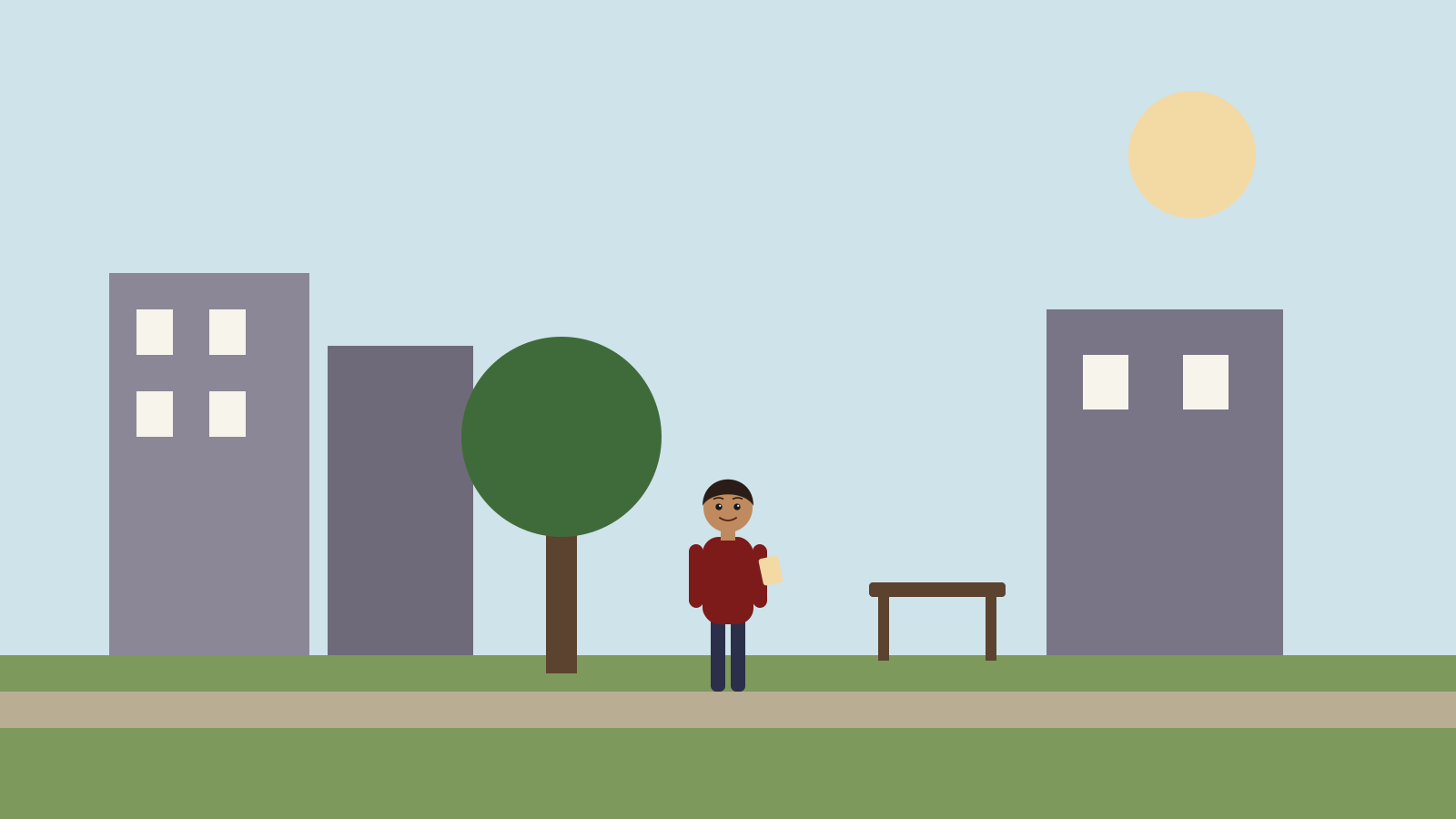 | The whole park and city. The person is tiny, so the place matters more than the face. |
| Long shot | 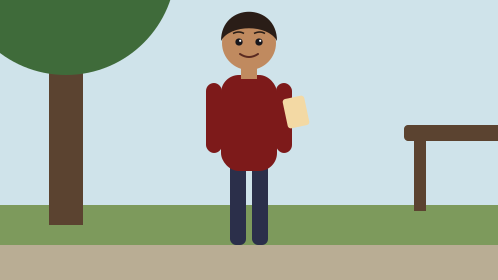 | Head to toe. We see what the person is doing and a little of where they are. |
| Medium shot | 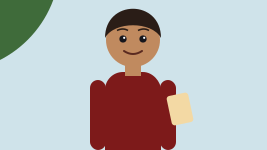 | Waist up. Face and body language share the frame, like someone across a table. |
| Close-up |  | The face fills most of the frame, so a small smile becomes the main event. |
| Extreme close-up |  | Only the eyes. A detail this close tells the audience: look here, this matters. |
Where the camera stands
The same person can feel different depending on the camera’s height and tilt. Here are some common angles:
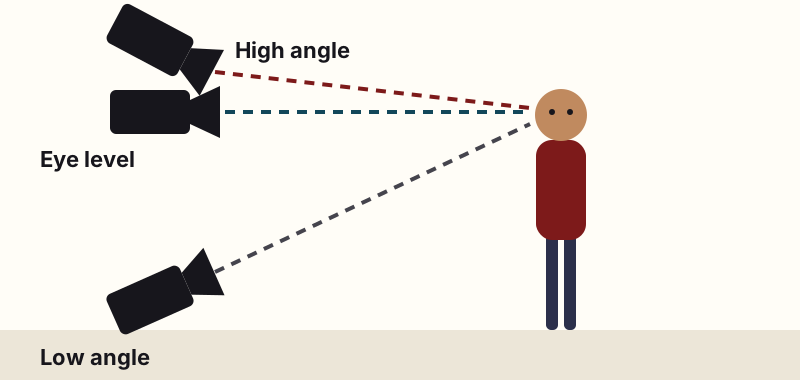
- Eye level
- The camera is even with the character’s eyes. This is how we see people in everyday life, so it often feels natural, like we are part of the scene.
- High angle
- The camera is above and looks down. Characters can seem smaller, weaker or more vulnerable.
- Low angle
- The camera is below and looks up. Characters can seem bigger, more important or more threatening.
- Bird’s-eye view (overhead)
- The camera looks straight down from above. It can show action you might not see from eye level.
- Canted angle (also called a Dutch angle)
- The camera is tilted sideways, so the horizon slants. It often makes a moment feel tense or off-balance.
When the camera moves
A camera can stay perfectly still, or it can move during a shot. Movement guides your eye and can change the mood.
| Movement | What happens | Often used to… |
|---|---|---|
| Pan | The camera stays in one spot and turns left or right. | Follow someone walking, or reveal a place bit by bit. |
| Tilt | The camera stays in one spot and tips up or down. | Follow someone climbing, or show how tall something is. |
| Tracking (dolly) shot | The whole camera travels, for example on a wheeled dolly or a stabilizing rig. | Move alongside the action, as if you are walking with it. |
| Handheld | The operator carries the camera, so the picture is a little bumpy. | Make you feel like you are right inside the action. |
| Zoom | The camera stays put; the lens changes to make things look closer or farther. | Push suddenly toward a detail. Used too much, it can feel distracting. |
Notice the difference between a zoom and a tracking shot. In a zoom only the lens changes. In a tracking shot the camera really travels through the space.
From shots to a sequence
Editing is where shots become a story. The most common style is continuity editing: cuts are arranged so the action seems smooth and the space makes sense, and you barely notice the cuts at all. Here are some of its tools:
- Shot/reverse shot
- In a conversation, the film cuts back and forth between the people talking.
- Eyeline match
- A character looks at something off-screen, then the film cuts to what they are looking at. Your brain connects the two.
- Match on action
- The cut happens in the middle of a movement. A person starts opening a door in one shot and finishes in the next, and the motion hides the cut.
- The 180-degree rule
- Imagine a line between two characters. Keep the camera on one side of it. If the camera “crosses the line,” characters who were facing each other can suddenly seem to face the same way.
- Jump cut
- Two very similar shots joined together, so the picture seems to jump. The 30-degree rule (move the camera at least 30 degrees between two shots of the same thing) helps editors avoid it.
A common pattern for a scene: start with an establishing shot, move to medium shots as people interact, then use close-ups for the most important feelings or details. Filmmakers break this pattern too, and noticing when they do is part of the fun.
Become a shot detective
How do film students study a scene? They slow it down. Try this with a one-minute scene from any movie or show you are allowed to watch.
- Watch the scene once just to enjoy it.
- Watch again with the sound off. Pause at every cut and count the shots.
- For each shot, write down its size, angle and any movement.
- Pick the two shots that matter most. For each, write one sentence: “The filmmaker used ___ so that I would notice ___.”
- Check your idea against the story. Does your reading still make sense in context?
Storyboard challenge
A storyboard is a set of quick sketches, one box per shot, that plans a sequence before anyone films. Stick figures are fine.
Plan a six-shot sequence for this moment: a student walks into an empty classroom and finds a mysterious box on the teacher’s desk.
- Draw six boxes. In each, sketch the shot and label its size, angle and any movement.
- Use at least one establishing shot, one close-up and one eyeline match.
- Under each box, write one line about why you chose it.
- If you have a phone or tablet and permission, film your storyboard and compare the result to your plan.
Talk about it
- Think of a scene that scared or surprised you. What shot sizes and angles do you remember?
- Why might a news interview usually stay at eye level, while a monster movie might not?
- Vertical phone videos have a tall frame. How does that change which shot sizes work best?
Self-guided quiz: read the frame
Nine questions. Choose an answer to see feedback right away, then check your score. Questions and choices shuffle each time. Your answers are not saved anywhere.
Try the interactive frame explorer and self-guided quiz at jugami.com/film/how-a-shot-tells-a-story/
Sources
Film terms and techniques are explained in our own words from BBC Bitesize Moving Image Arts guides, Central Connecticut State University Cinema Studies and a Yale National Initiative curriculum unit. The classroom scenario, storyboard prompt and self-guided quiz scenes are fictional teaching examples.
- BBC Bitesize (Moving Image Arts): Types of shot — a shot is a single unbroken recording; close-up, medium shot, long shot, extreme close-up
- BBC Bitesize (Moving Image Arts): Camera angles — eye level, low angle, high angle, worm’s eye and bird’s eye views
- BBC Bitesize (Moving Image Arts): Camera movement — pans, tilts and tracking (dolly) shots
- BBC Bitesize (Moving Image Arts): More camera movement techniques — handheld, crane, zoom and aerial shots
- BBC Bitesize (Moving Image Arts): Editing styles — continuity editing and the 180 degree rule
- BBC Bitesize (Moving Image Arts): Other continuity editing techniques — shot/reverse shot, match on action, eyeline match
- Central Connecticut State University, Cinema Studies: Cinematography — camera distance from extreme long shot to extreme close-up
- Yale National Initiative curriculum unit 06.01.09: film terms — establishing shot, camera angles, Dutch (canted) angle
- Library of Congress, Kluge Center blog: “The First Woman Director and the Beginning of Cinema” (2020) — Gaumont secretary from 1894, Solax president, Flushing and Fort Lee
- Library of Congress, Kluge Center blog: “Part 2: The First Woman Director and the Beginning of Cinema” (2020) — the Library holds the largest collection of her Solax productions
- Columbia Magazine: “Uncovering the History of Women in Silent Film” — Alice Guy Blaché (1873–1968) made her first film in 1896 and lectured at Columbia in 1917
- Women Film Pioneers Project (Columbia University Libraries): Alice Guy Blaché profile — lived July 1, 1873 – March 24, 1968; worked in France and the United States
Colophon: every drawing on this page (the park scene, the film strip, the camera-angle diagram and the share image) is original art made for Jugami. No third-party images, fonts or scripts are loaded. No quotations from Alice Guy-Blaché are used, and the teacher character’s tips are modern classroom advice, not historical statements.