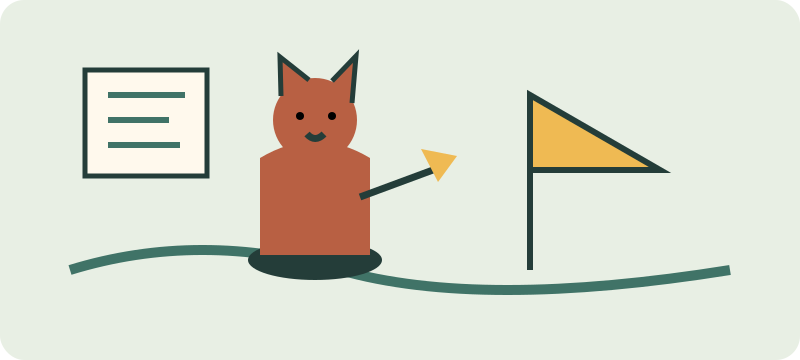
A fox. A windy pond. A boat that will not move. Tiny ideas can become a story! In this lesson, you will plan a character, a setting and a problem. Then you will tell what happens.
You may draw, speak or write. A grown-up can write down the words you say. There is no need to write a long story today.
The Bell for the Boat
An original story for this lesson
Pip the fox lived beside a pond. One afternoon, a little paper boat blew into the reeds. The boat was stuck.
Pip wanted to set it free. He reached with a stick. The stick was too short.
Then Pip spotted a string tied to the boat. He could not reach the string either. Pip rang his little bell. Ada the duck paddled over.
Ada carried the loose end of the string to the bank. Pip gave it a gentle tug. The boat slipped out of the reeds.
Pip let go. The boat sailed across the pond. Pip rang his bell again, just for joy.
The story map
A story map is a plan that helps you keep track of a story. Here is a map of our model story.
Character: who?
Pip, a fox who wants to help. Ada helps him.
Setting: where and when?
Beside a pond, one afternoon.
Problem: what gets in the way?
The paper boat is stuck in the reeds.
Try: what does Pip do?
He reaches with a stick. Then he asks Ada for help by ringing a bell.
Ending: what changes?
Ada brings the string. Pip tugs it. The boat is free.
Our map is a tool, not a rule for every story. Today we will use it to make one small adventure.
A character who wants something
A character is a person, animal or made-up being in a story. Give your main character a wish. What do they want? Pip wants to free the boat.
Try a shy dragon who wants to join a song. Or choose a child who wants to return a lost mitten. A wish gives your character a reason to act.
Your turn: Draw your character. Tell one thing they want. You can begin, “My character wants…” You do not need to use your own name or tell a true story about yourself.
A place and a time
The setting is where and when a story happens. Our story happens beside a pond, one afternoon. Those details help you picture Pip’s world.
Pick a place your character can move through: a garden, a kitchen or a cloud castle. Then choose a time: morning, winter or bedtime.
Add one detail you can see or hear. Instead of “a garden,” try “a garden where dry leaves crackle.” Choose a detail that fits your story. You do not need to describe everything.
A small problem
A problem is something that gets in the character’s way. Pip wants the boat to move, but the reeds hold it still.
Your problem can be gentle. A dragon wants to sing, but cannot remember the tune. A child wants to return a mitten, but does not know who owns it.
Your turn: Say your character’s wish. Add “but” and a problem. For example: “My dragon wants to sing, but she has forgotten the tune.” This connects the wish and the problem.
A try, then a change
Let your character try to solve the problem. In our model, Pip’s stick is too short. That try does not work. So Pip changes the plan and gets help.
For your dragon, humming alone might not bring back the tune. Next, she could ask a bird to hum the first notes. Tell how the next try grows from the first one.
Use words such as “first,” “then” and “at last” if they help the reader follow your events. You can also tell the events clearly without those words.
An ending that fits
An ending tells how things turn out. In our model, the boat floats free. That fits the stuck-boat problem. A surprise hat would not explain what happened to the boat!
For this practice story, give the problem a solution. Your dragon might remember the song after the bird helps. Show the change with an action: she opens her mouth and sings along.
You can end with a feeling or a small image, too. Pip’s last bell ring shows his joy. You do not have to write “The end.”
Practice problems
No separate worksheets are included in this first unit. Use plain paper for this open-ended story plan. There is no single right story.
Draw or name a character. What do they want?
Choose a place and a time. Add a sound or a sight.
Tell a problem that gets in the way.
Tell a first try. What happens?
Tell a next try and an ending that fits.
Now cover the plan and tell your story aloud. If you lose your place, peek at the map. Then write it down, or ask a helper to write your spoken words. Younger storytellers can draw a beginning, a middle and an end.
Make the words clearer
To revise means to change your work to make it clearer or stronger. Read your story aloud. Can a listener tell who wants what? Does each event lead to the next?
Try changing a vague action into a clear one. “Pip did something” becomes “Pip tugged the string.” Now you can picture the action.
Check your ending. Does it answer the problem you began with? If not, change the ending or change the problem. Finish by naming one part you like. A story can grow a little at a time.
Self-guided quiz
Choose one answer in each group. Feedback explains each choice. Your score counts your current correct choices; you may change your mind.
Score: 0 / 6
Tell it your way
Try telling your story with a different setting. What changes if your dragon sings on a snowy hill instead of in a sunny garden? Keep the version you like best. Storytelling means making choices, not guessing what your teacher secretly wants.
Sources
Teaching references for story elements and story maps. The fox story, practice ideas and artwork are original Jugami material, not quotations from Hans Christian Andersen.