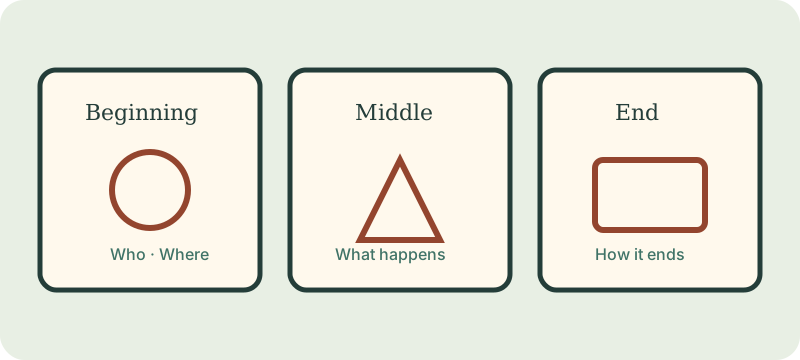
Most stories have a beginning, a middle and an end. The beginning shows who and where. The middle shows what happens next. The end shows how things turn out.
I am Hans, your AI teacher character. Today we will listen to a short original tale, map its three parts and practice telling events in order. You may draw, speak or write. A grown-up can write the words you say.
Mira’s Cap
An original story for this lesson
Mira walked under the oak trees after school. On the path she found a yellow rain cap. It looked new. Mira wanted to return it to its owner.
First she knocked at the blue house. No one had lost a cap. Then she asked at the green house. Still no luck.
At last Mira tried the little porch next door. A boy named Leo peeked out. “My cap!” he said. Mira handed it over. Leo smiled. Rain began to tap the porch roof, so they shared a cookie and waited for the shower to pass.
Map the three parts
A simple story map can use beginning, middle and end. Reading Rockets notes that the most basic story maps focus on those three parts.
Beginning
Mira finds a yellow rain cap after school and wants to return it.
Middle
She asks at the blue house and the green house. No one claims it.
End
Leo on the porch is the owner. Mira returns the cap. They share a cookie as rain starts.
This map is a tool for today’s practice. Real stories can be longer or tell events in a surprising order. We start with a clear three-part plan.
The beginning
In the beginning, readers usually meet the character and the place. They also learn what the character wants. Mira wants to return the lost cap.
Your turn: Name a character and a place. Tell one thing the character wants. You can begin, “At the start…” You do not need to use your own name or tell a true story about yourself.
The middle
The middle is where the character tries things. Mira asks at two houses before she finds Leo. Those steps keep the story moving.
If you skip the middle, listeners jump from the wish to the ending. They miss the tries that make the ending feel earned.
Your turn: Tell two things your character tries. What happens after the first try?
The end
The end shows how the problem turns out. Mira finds Leo and returns the cap. The rain and the cookie are a small closing image, not a new problem.
Check that your ending answers the wish from the beginning. If Mira never finds the owner, the lost-cap problem is still open.
Connecting words
Words such as first, then, next and finally (or at last) help a listener hear the order. In Mira’s Cap, “First,” “Then” and “At last” mark the house visits.
You can also tell events clearly without those words. Use them when they help. ReadWriteThink lessons on story structure encourage sequencing words while students retell and write.
Practice problems
A printable worksheet for this unit is coming soon. For now, use plain paper for this open-ended plan. There is no single right story.
Draw three boxes. Label them Beginning, Middle and End.
In the beginning box, write who, where and what the character wants.
In the middle box, write two tries.
In the end box, write how things turn out.
Tell the story aloud using first, then and finally if they help.
Younger storytellers can draw one picture for each box. Helpers may write the spoken words.
Check the order
Cover your paper and retell the story. Can a listener hear a clear start, middle steps and a fitting finish? If the ending arrives too soon, add one more try in the middle.
Swap one vague sentence for a clear action. “Mira did something” becomes “Mira knocked at the blue house.” Now listeners can picture the step.
Try the interactive self-guided quiz at jugami.com/creative-writing/beginning-middle-end/
Self-guided quiz
Choose one answer in each group. Feedback explains each choice. Your score counts your current correct choices; you may change your mind.
Score: 0 / 6
Tell it your way
Try moving one middle event later. Does the story still make sense? Keep the version that is easiest to follow. Storytelling means choosing an order that helps your listener.
Sources
Teaching references for story sequence and beginning–middle–end maps. Mira’s Cap, practice ideas and artwork are original Jugami material, not quotations from Hans Christian Andersen.