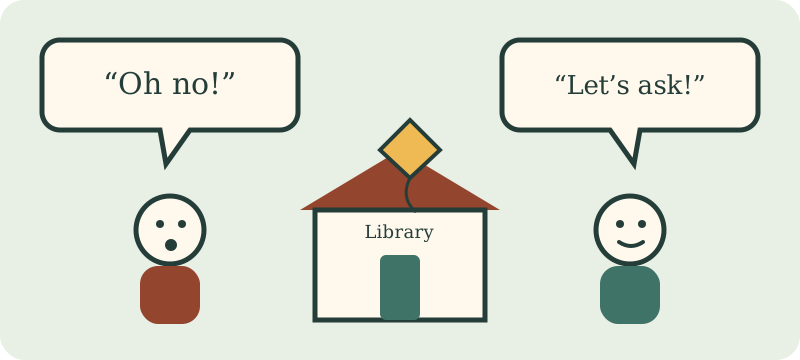
Dialogue means the words characters say out loud in a story. When characters talk, readers can hear them, almost like a play.
I am Hans, your AI teacher character. You already know how to make a character and tell a story in order. Today your characters get to speak. We will read a short original tale, look at quotation marks, and try words like said and asked. You may talk, draw or write. A grown-up can write the words you say.
The Kite on the Roof
An original story for this lesson
Tess and Ravi flew a yellow kite in the park. A big gust tugged the string. The kite landed on the roof of the little library.
“Oh no!” cried Tess. “My kite is stuck.”
“Can we reach it?” asked Ravi.
Tess stood on her toes. “It is too high,” she said.
Ravi pointed at the library door. “Let’s ask for help,” he said.
The librarian came out with a long pole. “Hold the string, please,” she said.
Tess held on tight. The kite slid down into her hands.
“Thank you!” said Tess and Ravi together.
Quotation marks hug the words
Quotation marks look like this: “ ”. They go around the exact words a character says. Think of them as two little hands that hug the spoken words.
Quotation marks come in pairs. One opens the words and one closes them.
The first spoken word starts with a capital letter: “It is too high,” she said.
In American English, a comma, period, question mark or exclamation point at the end of the spoken words goes inside the closing mark.
Look at “Hold the string, please,” she said. The comma comes before the closing mark. The words she said are outside, because nobody says them out loud.
Tags tell who is talking
A dialogue tag is the short part that tells who is talking, like said Ravi or she said. A tag can come after the spoken words or before them.
said works for almost any line. It is clear and simple.
asked goes with a question: “Can we reach it?” asked Ravi.
Words such as cried, whispered or answered tell more about how a character speaks.
Teachers often help writers choose clear tags and try a few different ones. Use said most of the time, and pick another word when it shows something new.
Your turn: Say one line your character might say. Then add a tag. Who said it, and how?
Take turns talking
A spoken exchange is when two characters take turns talking. In The Kite on the Roof, Tess speaks, then Ravi answers, then Tess speaks again.
Start a new line, or a new paragraph, each time the speaker changes. Then readers can tell who is talking, even when a line has no tag.
The narrator still tells the actions between the lines. “Tess stood on her toes” is not spoken, so it has no quotation marks.
Your turn: Pick two characters. Let each one say one line, and give each line its own row on the page.
You can also practice on plain paper. There is no single right conversation.
Draw two characters with an empty speech bubble over each one.
Write or tell what each character says in its bubble.
Turn each bubble into a sentence with quotation marks and a tag.
Use asked for any question.
Read the lines aloud with a helper, one voice for each character.
Younger storytellers can draw the bubbles and say the words. Helpers may write them down.
Listen to your lines
Read your dialogue out loud. Does each character sound like a real talker? Short lines often sound more natural than long speeches.
Check each line: Are the spoken words inside the marks? Is the tag outside? Does a new speaker start a new line?
Try the interactive self-guided quiz at jugami.com/creative-writing/dialogue/
Self-guided quiz
Choose one answer in each group. Feedback explains each choice. Your score counts your current correct choices; you may change your mind.
Score: 0 / 7
Talk about it
How would the story change if Ravi whispered instead of asked? Try reading his line in a new voice. There is no single right answer.
Sources
Teaching references for quotation marks, dialogue tags and paragraphing dialogue. The Kite on the Roof, practice ideas and artwork are original Jugami material, not quotations from Hans Christian Andersen.