
 Jugami World Religions
Unit 1 · Grades 6–8 · The scholar’s toolkit
Studying Religions Fairly
How do you learn about a religion that isn’t yours, or study your own with fresh eyes, without preaching, poking fun or getting the facts wrong? Scholars have a method. Here it is.
By the end of this unit you can…
- explain the difference between learning about a religion and being taught to follow one;
- turn a judgment into a fair description;
- name three big ideas scholars keep in mind about every religion;
- use seven “dimensions” to look at all sides of a tradition;
- read world religion statistics and say where they come from.
1. Teaching about, not teaching to believe
In 1974 a religious studies scholar named James V. Panoch wrote guidelines for telling the difference between teaching a religion and teaching about religion. A version of them is quoted in the American Academy of Religion’s 2010 guidelines for schools. The first line sums up the whole idea:
“The school’s approach to religion is academic, not devotional.”
Guideline quoted in American Academy of Religion, Guidelines for Teaching About Religion in K–12 Public Schools in the United States (2010), from the First Amendment Center’s A Teacher’s Guide to Religion in the Public Schools.
The other guidelines say the school aims for your awareness of religions but does not push you to accept any; it sponsors study about religion, not the practice of religion; it can show you many religious views but may not impose one; and it educates about all religions without promoting or putting down religion.
Why bother? The AAR’s guidelines rest on three points: not knowing much about religion is widespread, that lack of knowledge fuels prejudice, and careful, non-devotional teaching can reduce it.
2. Describe before you decide
A scholar’s first job is to describe: what do people do, what do they say it means, and who does it? Judging whether a belief is true or a practice is good is a different question, and it is not the job of this class.
A judgment
“That ceremony is strange.”
“Their holiday is better than ours.”
“Everyone in that religion thinks the same thing.”
A description
“In this ceremony, people light candles and recite a blessing.”
“For many families, this holiday centers on a shared meal.”
“Members of this tradition disagree about some questions.”
Three small habits make a big difference:
- Count carefully. Say “many,” “some” or “most” unless a source supports “all.”
- Give credit to the speaker. Write “According to Buddhist teaching…” or “Many Christians believe…” instead of stating a belief as a plain fact. Ninian Smart does this himself when he describes Jesus’ death as saving humankind “(according to Christians).”
- Use people’s own words. Call groups and practices by the names their members use.
3. Three big ideas about every religion
The AAR guidelines ask every lesson about religion to carry three premises. Keep them in your back pocket for the rest of this course.
Religions are internally diverse
One name can cover many ways of believing and practicing. Smart compares a Baptist chapel in Georgia, with plain services of hymns, Bible reading and preaching, to an Eastern Orthodox church in Romania, with candles, icons, processions and chanting. Both are Christian. The AAR adds that Muslims in Indonesia practice differently from Muslims in Nigeria, so a question like “What do Muslims believe?” is harder to answer than it looks.
Religions are dynamic
Religions change. Believers interpret and reinterpret their traditions in new times and places. The AAR’s example is the Confucian concept of the “mandate from heaven”: it changed across dynasties, regions and historical eras, and it is still changing today. So no practice or belief has just one meaning frozen for all time.
Religions are embedded in culture
Religion is woven into art, food, music, politics, calendars and family life, and culture shapes religion in return. That is why a World Geography or history lesson so often runs into religion, and why this course keeps culture in view.
4. Seven sides of a religion
If you only read a religion’s holy books, you might miss most of what its members actually do. The scholar Ninian Smart suggested looking at seven dimensions so that a description covers both ideas and practices.
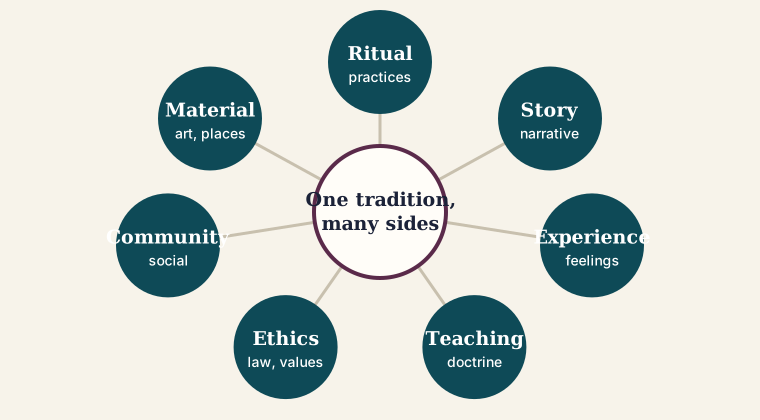
- Ritual (practical and ritual)Worship, prayer, preaching and practices such as meditation.
- Story (narrative or mythic)Sacred stories about founders, saints, creation or the end of time. Smart calls this “the story side of religion,” and in religious studies the word “myth” does not mean the story is false.
- Experience (experiential and emotional)Feelings such as awe, peace, hope or gratitude. Smart says “ritual without feeling is cold.”
- Teaching (doctrinal and philosophical)Formal ideas that explain a tradition’s worldview, like Christian teaching about the Trinity.
- Ethics (ethical and legal)How followers are taught to live, such as the Buddhist five precepts or the rules of Jewish law (halakha), rooted in the Torah.
- Community (social and institutional)How people organize: a church, the Buddhist Sangha, the Muslim umma, plus leaders, saints and teachers.
- MaterialBuildings, art and sacred places, such as Eastern Orthodox icons, statues of Hindu gods, the river Ganges or Mount Sinai.
5. Listen to many voices
Who should you ask about a religion? People who practice it can share something no textbook can: what it is like from the inside. But the AAR guidelines point out that one believer or one religious leader usually cannot speak for the whole range of their tradition, because traditions are so diverse.
- Don’t make a classmate the spokesperson. If someone chooses to share, thank them, and remember they are describing their own experience.
- Use several sources. Mix primary sources (sacred texts, buildings, art, interviews) with scholarly ones from universities, museums and encyclopedias.
- Watch out for the news. The AAR notes that media coverage of religion often focuses on dramatic events, which can give a distorted picture of everyday religious life.
6. How do we know? Counting the world
How many Buddhists, Christians or Hindus are there? Pew Research Center combined more than 2,700 censuses and surveys from 201 countries and territories. Many of them ask people something like “What is your religion, if any?” In other words, the numbers count how people identify themselves.
| Group | Share of world | Number (where Pew gives it) |
|---|---|---|
| Christians | 28.8% | 2.3 billion |
| Muslims | 25.6% | 2.0 billion |
| Religiously unaffiliated (“nones”) | 24.2% | 1.9 billion |
| Hindus | 14.9% | 1.2 billion |
| Buddhists | 4.1% | 324 million |
| Other religions combined | 2.2% | — |
| Jews | 0.2% | 14.8 million |
Shares add to 100%. “Other religions” includes Baha’is, Daoists, Jains, Shintoists, Sikhs, Wiccans, Zoroastrians and many smaller groups. A dash means this summary did not give a number.
Read the numbers like a scholar:
- Labels hide variety. Pew counts all Christian denominations as one group, and Sunni and Shiite Muslims as one group.
- Questions differ. The exact wording of census questions varies from country to country, so researchers have to sort many kinds of answers into seven categories.
- “None” isn’t always “no beliefs.” Pew notes that some religiously unaffiliated people still hold religious or spiritual beliefs or take part in practices.
- Numbers change. Between 2010 and 2020, Pew found that Muslims grew fastest, while Christians shrank as a share of the world, mostly because many people raised Christian stopped identifying with any religion.
Practice problems
No separate worksheet comes with this first unit. Use paper or a notebook for these prompts. They are open-ended, so there is no answer key, and they are different from the quiz questions.
- Fix the sentence. Rewrite each judgment as a fair description: (a) “Wearing special clothes to worship is old-fashioned.” (b) “People who fast are wasting a good lunch.” (c) “That temple is too fancy.”
- Seven-sides map. Pick a celebration you know well. It can be religious, or a non-religious one like a national holiday or a family tradition. Write one sentence for as many of Smart’s seven dimensions as you can. Which dimensions were easy, and which were hard to fill?
- Source detective. Find one source about a religious practice. Is it a primary source or a scholarly one? Who wrote it? Does it say “all” where “many” would be more accurate?
Talk about it
Why might it be harder to describe your own traditions fairly than someone else’s? What should you do if a classmate says something unfair about a religion? Is a survey label like “Christian” or “none” enough to tell you what a person believes? These questions have no single right answer.
Try the interactive self-guided quiz at jugami.com/world-religions/studying-religions/
Self-guided quiz: study like a scholar
Pick one answer for each question, then select “Check answers.” Every choice explains why it is or isn’t the best answer and where to reread. “Try again” clears your answers and shuffles the questions and choices. Nothing is sent or saved.
Sources
The method comes from the American Academy of Religion guidelines and Ninian Smart’s reading (quotations are copied from those texts). Statistics come from Pew Research Center’s 2025 report on 2020 data. All links checked November 9, 2026.
- American Academy of Religion (2010): Guidelines for Teaching About Religion in K–12 Public Schools in the United States (PDF)
- American Academy of Religion: about the K–12 Guidelines (non-devotional, academic study of religion)
- Ninian Smart, “The nature of a religion and the nature of secular worldviews,” from The World’s Religions (Cambridge University Press), reading hosted by Trinity University (PDF)
- Internet Encyclopedia of Philosophy: Religious Diversity, Theories of (lists Smart’s seven aspects of religious traditions)
- University of California Press: Ninian Smart, Dimensions of the Sacred (contents list of the dimensions)
- Pew Research Center (June 9, 2025): How the Global Religious Landscape Changed From 2010 to 2020
- Pew Research Center (June 9, 2025): Muslim population change, chapter 3 of the same report (2.0 billion Muslims in 2020)
- Georgetown University, Alwaleed Bin Talal Center for Muslim-Christian Understanding: Teaching About World Religions
Original art: the seven-dimensions diagram and share image were made for Jugami. Practice sentences are invented teaching examples.