Macbeth
Shakespeare’s tragedy of a brave soldier who murders his way to the Scottish throne, told act by act
Three witches stop a war hero on a lonely heath and tell him he will be king. He has never murdered anyone. By the end of the play he has stabbed his king, sent killers after his best friend and a mother with her children, and he can no longer sleep. Macbeth is Shakespeare’s shortest tragedy and one of his scariest, full of ghosts and blood that will not wash off.
The big question is who is really responsible. The witches only make predictions, and Lady Macbeth only talks. Macbeth is the one holding the dagger. This page starts with the history behind the play and a guide to who’s who. Then you can follow the story one act at a time, dig into the big ideas and the most famous lines, and finish with a quiz and some questions worth arguing about.
📖 Want to read the whole play? The Folger Shakespeare Library has a free, easy-to-read online edition with act, scene and line numbers. You can also download it free from Project Gutenberg.
The Real Scotland and King James
Shakespeare wrote this play with a new king in the audience’s mind.
When was it written?
Most scholars date Macbeth to about 1606, when Shakespeare was in his early forties. His acting company was now called the King’s Men, because King James I had become their patron in 1603. The play was first printed in 1623, seven years after Shakespeare died, in the big collection of his plays known as the First Folio.
A Scottish king in London
Queen Elizabeth I died in 1603 without children. Her cousin King James VI of Scotland inherited the English crown and became James I of England. A play about Scottish kings was a smart choice for a company that now performed for him.
Banquo, the royal ancestor
The Stuart kings, James’s family, traced their line back to a Scottish lord named Banquo. That helps explain why Shakespeare makes Banquo noble and innocent, and why the witches show Macbeth a parade of eight kings descended from him. Historians today think Banquo was a legend invented by later chroniclers.
The Gunpowder Plot
On 5 November 1605, a group of Catholic plotters tried to blow up Parliament with James inside. Guy Fawkes was caught in a cellar under the House of Lords guarding barrels of gunpowder. A play about killing a king would have felt very current. The drunken Porter even jokes about an “equivocator,” a person who lies by using words with double meanings. In 1606 that word was tied to the trial of Henry Garnet, a Jesuit priest accused of knowing about the plot.
Witches were taken seriously
James believed witches had tried to sink his ship with storms in 1590, and he sat in on the questioning of accused witches in the North Berwick trials. In 1597 he published a book about witchcraft called Daemonologie. In 1604 England passed a harsher law against witchcraft. When the witches on stage brew storms and curse a sailor, many in the audience believed such things could happen.
The real Macbeth
Macbeth was a real king of Scotland. He defeated and killed King Duncan I in battle at Pitgaveny, near Elgin, in 1040. The real Duncan was a younger man than the gentle old king of the play. Macbeth then reigned for 17 years and was settled enough to make a pilgrimage to Rome in 1050. He died fighting Duncan’s son Malcolm at the Battle of Lumphanan in 1057. Shakespeare took the story from Raphael Holinshed’s Chronicles and reshaped it into a tale of murder and guilt.
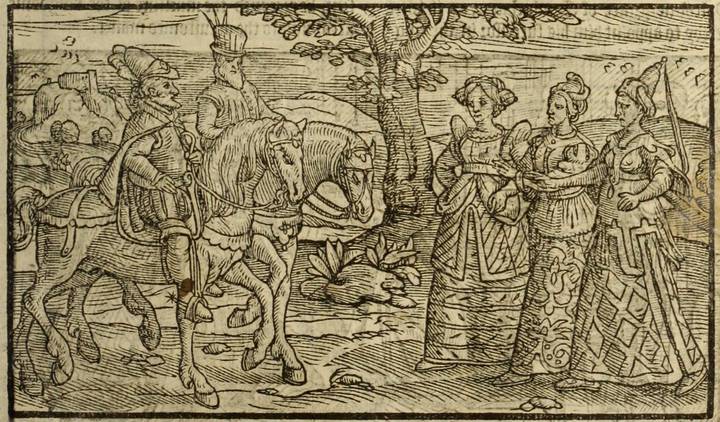
Shakespeare’s source, in pictures
This woodcut comes from the first edition of Raphael Holinshed’s Chronicles (1577), the history book Shakespeare borrowed the story from. It shows Macbeth and Banquo on horseback meeting the three “weird sisters.” Notice that they look like elegant ladies, not hags. Shakespeare turned them into bearded, spooky figures who “look not like the inhabitants o’ th’ earth.”
Image: woodcut of Macbeth and Banquo meeting the three women, from Raphael Holinshed’s Chronicles of England, Scotland and Ireland (1577), “The Historie of Scotlande,” page 243. Scan from the Boston Public Library copy via the Internet Archive. Public domain, via Wikimedia Commons.
What does “weird” mean here?
Shakespeare calls the witches the Weird Sisters. The word comes from the Old English wyrd, which means fate. So the name suggests sisters who know or control fate, which is much creepier than “strange.”
“The Scottish Play”
Many actors refuse to say “Macbeth” inside a theater and call it “the Scottish play” instead, because of an old superstition that the play is cursed. The curse stories are theater legend, but you may still hear actors avoid the name.
Main Characters
A king, the couple who kill him, and the people who come for revenge.
The Macbeths
- Macbeth
- Thane (lord) of Glamis and a fearless general in King Duncan’s army. He is brave in battle and has a powerful imagination, which makes him see daggers and ghosts. Once he starts killing, he finds it harder and harder to stop.
- Lady Macbeth
- His wife. She is the first to talk about murder out loud, and she mocks her husband when he hesitates. Later, guilt breaks her, and she walks in her sleep trying to wash invisible blood from her hands.
The Royal Family
- Duncan
- King of Scotland. He is generous and trusting, maybe too trusting. He rewards Macbeth with a new title and then spends the night in his castle.
- Malcolm
- Duncan’s elder son and heir. He flees to England after the murder and returns with an army.
- Donalbain
- Duncan’s younger son, who escapes to Ireland.
Banquo
Macbeth’s friend and fellow general. The witches tell him his descendants will be kings. He is tempted by the prophecy too, but he doesn’t act on it, and that makes him a mirror for Macbeth.
Fleance
Banquo’s young son. If he survives, the witches’ promise to Banquo can still come true.
Macduff
Thane of Fife, and the first to discover Duncan’s body. He suspects Macbeth early and becomes his deadliest enemy.
Lady Macduff and her son
Left alone at their castle when Macduff goes to England. Their scene is short, and it is one of the most painful in the play.
The Weird Sisters
Three witches who meet in thunder and lightning. They never tell Macbeth to kill anyone. They just tell him what will happen and let him do the rest. Their queen, Hecate, appears in two scenes that many scholars think were added by another playwright, Thomas Middleton.
Ross and Lennox
Scottish noblemen who carry news, good and terrible, and slowly turn against Macbeth.
The Porter
The drunken gatekeeper at Macbeth’s castle. He pretends he is the porter at the gate of hell, which is closer to the truth than he knows.
Siward
An English earl who leads ten thousand soldiers to help Malcolm. His son, Young Siward, dies fighting Macbeth.
The Plot, Act by Act
Watch for dramatic irony (we know something a character doesn’t) and foreshadowing (a hint of what is coming).
Act I
The Prophecy
Three witches, two new titles and one terrible idea
The play opens with thunder and three witches, who agree to meet Macbeth “when the battle’s lost and won.” Meanwhile, a bleeding captain tells King Duncan how Macbeth won the day against rebels, slicing one traitor open “from the nave to the chops.” Duncan orders the disloyal Thane of Cawdor executed and gives his title to Macbeth.
Before the news reaches him, Macbeth and Banquo cross a heath and meet the witches. They hail Macbeth as Thane of Glamis, which he already is, then as Thane of Cawdor, and finally as the man who “shalt be king hereafter.” Banquo, they say, will never be king, but his children will be. Moments later, the king’s messengers arrive and greet Macbeth as Thane of Cawdor. One prophecy has already come true, and Macbeth starts thinking about murder.
Duncan names his son Malcolm as heir, which puts someone new between Macbeth and the crown. Then he invites himself to Macbeth’s castle at Inverness. Lady Macbeth reads her husband’s letter about the witches and decides that Duncan will not leave alive. Macbeth wavers. He knows Duncan is his king, his relative and his guest. His wife calls him a coward, promises to drug the king’s guards, and talks him into it.
Act II
The Murder
A floating dagger, a knock at the gate and a king found dead
Late that night, Macbeth waits for his wife’s signal and sees a dagger hanging in the air, pointing toward Duncan’s room. He can’t grab it, and soon it is dripping with blood. A bell rings, and he goes to do the deed. We never see the murder, because Shakespeare keeps it offstage.
Macbeth comes back shaking, still holding the bloody daggers. He thought he heard a voice cry “Sleep no more!” Lady Macbeth scolds him, takes the daggers back to the room herself, and smears the sleeping guards with blood so they will look guilty. Then a loud knocking starts at the castle gate.
A hungover Porter finally opens the gate for Macduff and Lennox. Macduff goes to wake the king and runs out screaming. In the chaos, Macbeth kills the two guards, claiming he was too furious to stop himself. Lady Macbeth faints, and readers still argue about whether it is real. Duncan’s sons decide they are not safe and flee, which makes them look guilty. Macbeth is crowned king at Scone, but Macduff refuses to attend.
Act III
Banquo’s Ghost
The new king learns that one murder leads to another
Macbeth is king, yet he feels anything but safe. Banquo heard the prophecies too, and if his son Fleance becomes the father of kings, Macbeth will have murdered Duncan for someone else’s family. So he hires murderers to kill Banquo and Fleance as they ride back to the palace. This time he doesn’t tell his wife the plan. “Be innocent of the knowledge, dearest chuck,” he says.
The murderers ambush Banquo at dusk and kill him, but Fleance escapes into the dark.
That night Macbeth throws a grand feast for his lords. When he goes to sit down, he finds Banquo’s bloody ghost in his chair. Nobody else can see it. Macbeth shouts at the empty seat while his guests stare, and Lady Macbeth tries to cover for him before sending everyone home. Afterward, Macbeth decides he has waded so far into blood that turning back would be as hard as going on. He will visit the witches again. Meanwhile, word spreads that Macduff has gone to England to raise an army with Malcolm.
Act IV
The Cauldron
Three apparitions, a massacre and a grief too big for words
In a dark cave, the witches stir their cauldron (“Double, double, toil and trouble”) and summon three apparitions for Macbeth. An armed head warns him to beware Macduff. A bloody child says that “none of woman born” can harm him. A child wearing a crown and holding a tree promises he will never be defeated until Birnam Wood marches to his castle at Dunsinane. Macbeth feels unbeatable. Then the witches show him a line of eight kings, all descended from Banquo, with Banquo’s ghost smiling and pointing at them.
When Macbeth hears that Macduff has fled to England, he orders the murder of Macduff’s wife, children and servants. The killers find Lady Macduff and her son alone at home and kill them.
In England, Malcolm tests Macduff’s loyalty by pretending he would be an even worse king than Macbeth. Macduff passes the test. Then Ross arrives with the news about Macduff’s family. “All my pretty ones?” Macduff asks, unable to believe it. When Malcolm urges him to take it like a man, Macduff answers, “I must also feel it as a man.” With ten thousand English soldiers, they march for Scotland.
Act V
Birnam Wood Comes to Dunsinane
A queen walks in her sleep and the prophecies come due
At Dunsinane, a doctor and a gentlewoman watch Lady Macbeth sleepwalk with a candle, rubbing her hands and muttering about blood, Duncan and Lady Macduff. “Out, damned spot!” she cries. The woman who once said “a little water clears us of this deed” now believes that all the perfumes of Arabia couldn’t sweeten her hand.
Macbeth’s soldiers are deserting him, and his lords have joined Malcolm. He clings to the prophecies. Near Birnam Wood, Malcolm orders each soldier to cut a branch and carry it, to hide how big the army is. A cry goes up inside the castle. Lady Macbeth is dead. Macbeth answers with his famous speech about life being “a tale / Told by an idiot, full of sound and fury, / Signifying nothing.” Then a messenger reports that the wood seems to be moving.
Macbeth fights on and kills Young Siward, still sure that no man born of a woman can harm him. Then he meets Macduff, who tells him that he was “from his mother’s womb / Untimely ripp’d,” meaning he was delivered by an early cesarean birth. Macbeth refuses to surrender. “Lay on, Macduff,” he says (people often misquote it as “Lead on”), and they fight to the death. Macduff returns with Macbeth’s head. Malcolm, now king, calls Macbeth a “dead butcher” and his wife a “fiend-like queen,” and says she is thought to have taken her own life. He invites everyone to his coronation at Scone.
Key Themes
These ideas run through the whole play. Look for them in the speeches and the images.
Ambition
Macbeth admits that the only thing pushing him is “vaulting ambition,” the kind that jumps too high and falls. The play doesn’t say wanting success is evil. It asks what happens when wanting something matters more than how you get it.
Guilt and conscience
Guilt in this play is physical. Macbeth can’t sleep, sees ghosts and has a mind “full of scorpions.” Lady Macbeth seems tougher at first, yet guilt finally destroys her too. Watch how often the words blood, sleep and hands come back.
Fate or free will?
The witches predict that Macbeth will be king, but they never say how. Would he have become king anyway if he had waited? Banquo hears a prophecy too and does nothing wrong. That contrast suggests the choice belonged to Macbeth.
Things are not what they seem
“Fair is foul, and foul is fair,” chant the witches in the first scene. Smiling hosts hide murder plans, and prophecies that sound safe turn out to be traps. Lady Macbeth even tells her husband to look like an innocent flower and be the snake underneath.
What it means to be a man
Lady Macbeth wins the argument in Act 1 by saying a real man would do the murder. Macduff gives a very different answer when he hears his family is dead. For him, feeling grief is part of being a man.
Order and chaos
People in Shakespeare’s time believed a king was chosen by God. Killing one threw all of nature out of balance. After Duncan’s death, day turns dark and Duncan’s horses are said to eat each other. Order returns only when a rightful king takes the throne again.
Famous Quotes, in Plain English
Some of these lines are four hundred years old and still turn up in movies, songs and headlines.
“Fair is foul, and foul is fair: / Hover through the fog and filthy air.”
Good and bad are about to swap places. This paradox (a statement that seems to contradict itself) sets up a world where nothing can be trusted. Macbeth’s first line, “So foul and fair a day I have not seen,” echoes it before he has even met them.
“Look like the innocent flower, / But be the serpent under’t.”
Act friendly and harmless while you plan the attack. The serpent recalls the snake in the Garden of Eden, which tricked Eve into disaster.
“I have no spur / To prick the sides of my intent, but only / Vaulting ambition, which o’erleaps itself / And falls on th’ other.”
“I have no good reason to do this, only ambition.” He pictures a rider who leaps onto his horse so hard that he flies over and lands on the other side. It is a metaphor for ambition that ruins itself.
“Is this a dagger which I see before me, / The handle toward my hand?”
Alone on stage, Macbeth sees a dagger that isn’t there. This kind of speech is a soliloquy, where a character speaks their private thoughts aloud. Is the dagger a warning, an invitation, or just his own guilty mind?
“Will all great Neptune’s ocean wash this blood / Clean from my hand?”
Neptune was the Roman god of the sea. Macbeth thinks even the whole ocean couldn’t clean his hands. In fact, he says his bloody hand would turn the green sea red.
“O, full of scorpions is my mind, dear wife!”
His thoughts sting him like scorpions. He is king now, and he is more frightened than ever, mostly because Banquo and Fleance are still alive.
“Double, double, toil and trouble; / Fire, burn; and cauldron, bubble.”
The witches’ spell as they brew a disgusting stew of animal parts. Notice the beat. The witches speak in a short, chanting rhythm that sounds different from everyone else in the play.
“By the pricking of my thumbs, / Something wicked this way comes.”
“My thumbs are tingling, so someone evil is coming.” The someone is Macbeth. Even the witches now think of him as wicked.
“Out, damned spot! out, I say!”
Sleepwalking, she scrubs at a bloodstain only she can see. The woman who once said a little water would wash the deed away is now trapped by guilt she can’t remove.
“Life’s but a walking shadow; a poor player, / That struts and frets his hour upon the stage … it is a tale / Told by an idiot, full of sound and fury, / Signifying nothing.”
Hearing that his wife is dead, Macbeth decides life is meaningless, like a bad actor’s brief performance or a story that makes no sense. It begins with the famous line “Tomorrow, and tomorrow, and tomorrow.”
Quotations follow the Project Gutenberg text (#1533) in modern spelling, with act and scene numbers as in the Folger edition. Line numbers can differ between editions.
Test Yourself
Ten quick questions on the plot. Click or tap an answer to check it.
The Dunsinane Challenge
Answer key (for teachers and paper copies)
1 Thane of Cawdor · 2 His descendants will be kings · 3 Lady Macbeth · 4 Duncan’s two guards · 5 Fleance · 6 Banquo’s ghost · 7 None of woman born can harm him · 8 To help Malcolm raise an army · 9 Wash blood off her hands · 10 Soldiers carry cut branches
Talk About It
Questions to argue about in class or at home. None of them has one right answer.
- Who is most to blame for Duncan’s murder: Macbeth, Lady Macbeth or the witches? Rank them and defend your order with lines from the play.
- Banquo hears a prophecy too and never acts on it. What does his story tell us about Macbeth’s?
- Lady Macbeth is the stronger partner in Act 1 and falls apart by Act 5, while Macbeth goes the other way. Why do you think they switch?
- Shakespeare shows us the murders of Banquo and Lady Macduff’s son on stage but keeps Duncan’s offstage. Why might he make that choice?
- Is Macbeth a villain, a victim, or a tragic hero who could have been great? What would change your mind?
- Malcolm calls the Macbeths “this dead butcher, and his fiend-like queen.” Is that a fair summary of who they were?