
High School English · American Short Stories · Unit 5
Jack London and Naturalism
One man, one dog and seventy-five degrees below zero. A writer who went to the Klondike and came back with stories where nature makes the rules.
A man walks alone along a frozen creek in the Yukon. He spits, and the spit crackles in the air before it can land. He knows that means it is colder than fifty below, but not how much colder. It is seventy-five below. His dog knows something is wrong; he does not. Everything that follows comes from that gap between what he knows and what is true.
Jack London had walked trails like that one. He sailed to the Klondike in 1897 to look for gold, spent a winter there, got scurvy and came home with no fortune. Within a few years his stories of the North had made him one of the most famous writers in the world.
On this page: his life, a reader’s toolkit, guides to “To Build a Fire” and “The Law of Life” (summary, craft notes and questions), how London rewrote “To Build a Fire,” a note on his views about race, why the inevitable ending matters, a reading game, a quiz, and questions that connect the two stories.
Before you read. Both stories end in death from cold. In “To Build a Fire” a man freezes slowly, and at one point he tries to kill his dog to warm his hands. In “The Law of Life” an old man is left by his people to die, and wolves close in. The section on London’s views on race describes racist things he wrote; we explain them without reprinting slurs.
His Life: The Bay, the Sea, the Yukon and the Ranch
Jack London was born John Griffith Chaney in San Francisco on January 12, 1876. His father left before he was born. He took the surname of his stepfather, John London, and grew up poor in Oakland, across the bay. He left school young to work, and read constantly at the public library.
- 1876–1892 · San Francisco and Oakland. He works in a cannery and other jobs. With money borrowed from Virginia Prentiss, the woman who had nursed him as a baby, he buys a sloop, the Razzle-Dazzle, and becomes an oyster pirate, raiding oyster beds on the bay. Later he works for the government fish patrol.
- 1893 · At sea. At 17 he signs on to the sealing schooner Sophie Sutherland, bound for the coast of Japan. His first published work, “Typhoon off the Coast of Japan,” comes from the voyage.
- 1894 · On the road. In a year of economic depression he rides freight trains as a hobo, marches with Charles T. Kelly’s army of the unemployed and is jailed for vagrancy. Britannica says that in 1894 he “became a militant socialist.”
- 1897–1898 · The Klondike. After a short time at the University of California, Berkeley, he sails north on July 12, 1897, with his sister’s husband, Captain James Shepard, to join the Klondike Gold Rush. He spends the winter in the Yukon, finds no fortune and, like many badly fed miners, gets scurvy. He comes home in 1898 with the material for his best stories.
- 1899–1903 · The stories sell. Magazines begin buying his tales of the North. His first book, The Son of the Wolf, appears in 1900. “The Law of Life” runs in McClure’s Magazine in March 1901. In 1903 The Saturday Evening Post pays $750 for The Call of the Wild, and the novel makes him famous.
- 1901–1906 · Socialism. In 1901 he joins the new Socialist Party of America. He runs for mayor of Oakland as a socialist in 1901 and 1905, loses both times, and lectures on socialism around the country.
- 1905–1913 · Beauty Ranch. He buys land at Glen Ellen in Sonoma County and builds it into a large ranch he called Beauty Ranch. “To Build a Fire” appears in The Century Magazine in August 1908. On the ranch he builds Wolf House, a huge stone mansion. It burns late on the night of August 22, 1913, shortly before he and his wife Charmian plan to move in.
- 1916 · Glen Ellen. Early in the year he resigns from the Socialist Party. He dies at the ranch on November 22, 1916, at 40, and his ashes are buried near the ruins of Wolf House. The land is now Jack London State Historic Park.
Britannica calls him “the highest-paid writer in the United States” of his time, and says “his earnings never matched his expenditures.” He wrote about 50 books in 17 years. The Jack London Online Collection at Sonoma State University describes him as a “proud socialist” and also names his “dark side”: depression, heavy drinking, “anti-Semitism, and mixed ideas about race.” The section on his views on race looks at that side.
The Reader’s Toolkit
Five tools you will use in both stories.
Naturalism
Naturalism is a kind of realist fiction that shows people controlled by forces bigger than they are: nature, heredity, hunger, cold. Characters are not punished for being bad or rewarded for being good. They are animals in a world that does not care. Britannica calls “To Build a Fire” “a masterly depiction of humankind’s inability to overcome nature.”
Setting as antagonist
An antagonist is whatever works against the main character. In most stories it is a person. Here it is the cold. The Yukon has no plan and no anger; it simply follows its own rules. Watch how every mistake the man makes is a mistake about the setting.
Third-person narration
The narrator in “To Build a Fire” tells us what the man thinks, but also what he does not know. It tells us the true temperature, judges him “without imagination,” and explains the dog’s instinct. That gap between narrator and character is where the tension comes from.
Foreshadowing
Foreshadowing is a hint of what will come. The old-timer’s warning, the crackling spit and the dog’s fear all point ahead. In “The Law of Life,” a memory of wolves and an old moose tells us how the story will end long before it does.
The inevitable ending
An inevitable ending is one the story has been heading toward all along. It is the opposite of O. Henry’s twist. The surprise is not what happens; it is watching each small choice close off another way out.
Read with a pencil. Each time the man in “To Build a Fire” makes a choice, mark it. At the end, count how many choices led to the last scene.
To Build a Fire
Story · The Century Magazine, August 1908 · collected in Lost Face (1910) · Read it free at Project Gutenberg
Summary. “Day had broken cold and grey, exceedingly cold and grey, when the man turned aside from the main Yukon trail.” It is nine o’clock and there is “no sun nor hint of sun.” The man, who is never named, is heading for an old claim on the left fork of Henderson Creek, where “the boys” are already in camp. He hopes to be there by six. He is “a new-comer in the land” and this is his first winter. “The trouble with him was that he was without imagination.” To him, “Fifty degrees below zero was to him just precisely fifty degrees below zero.”
He spits, and there is “a sharp, explosive crackle.” He knows spit crackles on the snow at fifty below, “but this spittle had crackled in the air.” At his heels trots “a big native husky, the proper wolf-dog.” The dog is uneasy. “Its instinct told it a truer tale than was told to the man by the man’s judgment.” The narrator gives the real number: “It was seventy-five below zero.”
The creek hides springs under the snow. The man watches for them, and at half-past twelve he reaches the forks and builds a fire to eat his lunch. Then, “at a place where there were no signs,” he breaks through and wets himself “half-way to the knees.” He must build a fire to dry his feet. He does it well, and smiles at the advice of “the old-timer on Sulphur Creek” that no man should travel alone after fifty below. He decides “those old-timers were rather womanish, some of them.”
But he has built the fire under a spruce. Every twig he pulls shakes the tree. A bough tips its load of snow, it brings down the boughs below, and “the fire was blotted out!” “It was as though he had just heard his own sentence of death.” His fingers will not work. He drops his matches, lights one with his teeth, then lights all seventy at once and burns his hands to start a new fire. A piece of moss falls on it, his shivering scatters it, and it goes out.
He tries to kill the dog to warm his hands inside its body, but he cannot hold a knife. He runs until he falls. At last he decides he has been “running around like a chicken with its head cut off” and should meet death “decently.” He imagines the boys finding his body. “You were right, old hoss; you were right,” he mumbles to the old-timer. He falls asleep. The dog waits, catches “the scent of death,” and trots off toward camp, “where were the other food-providers and fire-providers.”
Clues and craft
- No name: the man is only “the man.” He could be anyone who trusts his own judgment too much, which makes him easier to see yourself in.
- The dog as a measure: the dog never makes a mistake. It wants to dig in and wait. London uses it to show what instinct knows and judgment misses.
- The narrator knows more: we learn the real temperature from the narrator, not the man. That is dramatic irony, and it makes us watch every choice with dread.
- Small steps: nothing he does is foolish on its own. Wet feet, a good fire, a convenient tree. Each step closes off a way out.
- The old-timer: mentioned again and again, never seen. His warning hangs over the story like a rule the man is breaking.
- The last line: the story ends with the dog, not the man. Nature goes on; one man’s death changes nothing.
Discussion questions
- The narrator says the man was “without imagination.” What does imagination have to do with surviving the cold?
- Find two places where the dog knows more than the man. How does London show what the dog knows without letting it think in words?
- Which single choice do you think doomed the man? Defend your answer, then argue for a different one.
- The story ends with the dog trotting off toward the camp. Why end with the dog instead of the man?

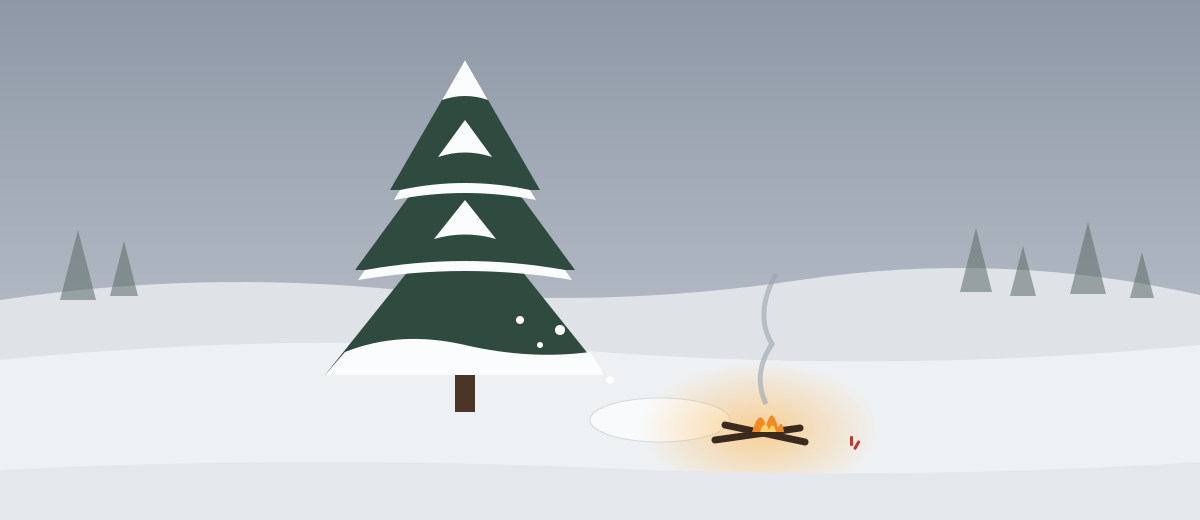
“Then it turned and trotted up the trail in the direction of the camp it knew.” Original art made for Jugami.
Two Versions of the Story
London published a story called “To Build a Fire” twice, and they are not the same story. The first appeared in The Youth’s Companion, a magazine for young readers, on May 29, 1902. The second, the one most people read now, appeared in The Century Magazine in August 1908 and was collected in Lost Face in 1910.
- 1902: the man has a name, Tom Vincent. There is no dog. It is not as cold. His fire is not put out by snow. He survives with lasting frostbite and becomes, in the words of the Wikipedia summary, “a more melancholic but wiser person.”
- 1908: the man has no name. A dog goes with him. It is seventy-five below. The fire is blotted out, the second fire fails, and he dies.
The first version is a lesson: be careful and you will learn. The second is naturalism: being careful is not enough, because the cold does not care. Ask what the dog adds, and why London took away the man’s name.
The Law of Life
Story · McClure’s Magazine, March 1901 · collected in Children of the Frost (1902) · Read it free at Project Gutenberg
Summary. “Old Koskoosh listened greedily.” He is blind, and he sits by a small fire in the snow while his people break camp around him. He hears his granddaughter, Sit-cum-to-ha, beating the dogs into their harnesses, and the lodges coming down one by one. His son, the chief, is “a mighty hunter.” The tribe is hungry, the trail is long, and Koskoosh is too old to travel. They are leaving him behind, as was their custom with the very old.
His son comes back for a moment. “Is it well with you?” “It is well.” “There be wood beside you,” the son says, “and the fire burns bright.” Koskoosh answers, “I am as a last year’s leaf, clinging lightly to the stem.” The son leaves. Now “the measure of his life was a handful of fagots.” When the last stick burns, the frost will come.
He does not complain. “It was the law of all flesh.” Nature “had no concern for that concrete thing called the individual. Her interest lay in the species, the race.” He remembers the women and men he knew, and then a day in his boyhood when he and his friend Zing-ha followed the track of an old bull moose that wolves had cut out from the herd. They found where it made its last stands, and then they found what was left of it.
The fire burns down. A wolf howls close by. “A cold muzzle thrust against his cheek.” He grabs a burning stick and waves it, and a ring of wolves gathers round. Then he asks himself, “Why should he cling to life?” He drops the stick into the snow. “Again he saw the last stand of the old bull moose, and Koskoosh dropped his head wearily upon his knees. What did it matter after all? Was it not the law of life?”
Clues and craft
- Sound, not sight: Koskoosh is blind, so the story is built from what he hears: crackling hides, whining dogs, the last crunch of snow. When the sounds stop, he is alone.
- Time as fuel: each stick is a piece of his life. London makes an abstract idea, the end of time, into something you can count.
- The moose: a memory that is also a prediction. It is the story’s foreshadowing and its ending at once.
- No villain: his son is “good to do this thing.” The tribe is not cruel; it is hungry. The law is nature’s, not anyone’s choice.
- A choice at the end: unlike the man in “To Build a Fire,” Koskoosh lets go. Is that defeat, or understanding?
Discussion questions
- Why does London tell this story through a blind man? What would be lost if Koskoosh could see?
- Koskoosh says, “It is well.” Does he mean it? Find evidence on both sides.
- How does the memory of the moose prepare you for the ending?
- The narrator calls Koskoosh’s mind “barbaric.” What does that word tell you about the narrator, and about 1901?
London’s Views on Race
London wrote about workers’ rights and called himself a socialist for most of his adult life. He also held racist views that were common among white Americans of his time, and he put some of them in print. Students can study his stories and still be honest about this.
- Jack Johnson. In 1908 Jack Johnson became the first Black world heavyweight boxing champion. London, writing about boxing for newspapers, openly called for a white boxer to beat him. Two days before Johnson fought the former champion Jim Jeffries in 1910, London described Jeffries as “the chosen representative of the white race, and this time the greatest of them.” Johnson won in the fifteenth round.
- “The great white hope.” The phrase is often credited to London. Wikipedia notes that the term was used outside boxing in the 1800s, and that a famous line about saving “the white race” was added later by a boxing writer, Nat Fleischer. What is clear from London’s own writing is that he wanted a white champion.
- Asian immigration. In 1904 he wrote an essay called “The Yellow Peril,” using a racist phrase of the day about fear of China and Japan. Yet he ended it by admitting his own view might be “a product of Western race-egotism.”
- Other stories. Some of his stories, such as “The Mexican,” “The Chinago” and “Koolau the Leper,” treat people of color with sympathy and show the cruelty of white power. In “The Law of Life” the narrator respects Koskoosh’s calm but also calls his mind “barbaric.”
- Socialism and race. London’s socialism spoke for working people, but in his time many white socialists did not count all workers equally. The Sonoma State collection sums him up as having “mixed ideas about race.” Both things were true of him at once.
In class, talk about the ideas and the time, not about classmates. Quote London’s racial writing only when you need it as evidence.
The Inevitable Ending
O. Henry’s twist
In “The Gift of the Magi,” the last page surprises you: each gift is useless because of the other’s sacrifice. The ending depends on a fact held back until the end.
London’s inevitability
“To Build a Fire” holds nothing back. The narrator tells you the temperature in the first pages. The tension is not about what will happen, but about whether the man will see it in time.
Chopin’s turn
“The Story of an Hour” sits between them: a surprise in the last line that changes the meaning of what came before. It is a twist, but one that reveals a truth instead of a trick.
Why it matters
An inevitable ending asks you to reread for causes, not clues. Ask: where could the man have turned back? London’s answer is that the chances were there, and he did not see them.
The whole course. From Irving’s legends to Harte’s mining camps, Chopin’s irony and O. Henry’s twists, each writer found a new way to end a story. London ended his with nature. Which ending in this course felt most true to you?
Read the Signs
Find the Detail That Points Ahead
Eight rounds, four from each story. Each round asks a question and gives three real details from the story. Choose the one that answers it. A right pick is marked ✓ Right; a wrong pick is marked ✗ Try again, and you can choose again. Your score counts first tries.
Answer key
- His spit crackles in the air before it can fall to the snow
- Its instinct tells it “a truer tale” than his judgment
- Building the fire under a snowy spruce
- “You were right, old hoss; you were right.”
- “The measure of his life was a handful of fagots”
- He tells his son, “It is well,” and lets him go
- An old bull moose pulled down by wolves
- Nature’s “interest lay in the species, the race”
Quiz
The Jack London Quiz
Choose one answer per question. Your pick is marked ✓ if it is right or ✗ if it is not, the right answer is marked ✓, and a short explanation follows. Your score appears at the end.
Answer key
- San Francisco, California
- He raided oyster beds as an oyster pirate
- Toward the coast of Japan
- Scurvy
- The Call of the Wild
- It burned in 1913, before they moved in
- The Century Magazine
- The man survives, frostbitten and wiser
- Seventy-five below zero
- The old-timer on Sulphur Creek
- It trots off toward the camp
- A small fire and a heap of wood
- That Jeffries was “the chosen representative of the white race”
- Stories of people shaped by forces they cannot control
Connecting the Stories
For class or for your own journal. Use evidence from both stories.
- Both stories end with a man alone in the snow as his fire fails. Compare how each man faces it. Which ending is harder to read, and why?
- The man in “To Build a Fire” ignores advice; Koskoosh accepts the law of his people. Does either choice change the outcome?
- In one story a dog leaves a dying man; in the other, wolves close in. What role do animals play in London’s idea of nature?
- London rewrote “To Build a Fire” so the man dies. Which version do you think is better, and what does the change tell you about naturalism?
- Choose one story from an earlier unit in this course. How would London have ended it?
- Write a scene of about 300 words in which a character faces a setting that does not care about them: heat, a storm, a flood. Use a narrator who knows more than the character, and plant one warning early.
Sources and Credits
- Jack London, “To Build a Fire” (1908 version), in Lost Face (1910), Project Gutenberg eBook #2429 (gutenberg.org/ebooks/2429).
- Jack London, “The Law of Life,” in Children of the Frost (1902), Project Gutenberg eBook #10736 (gutenberg.org/ebooks/10736).
- The Jack London Online Collection, Sonoma State University Library (london.sonoma.edu) (a “proud socialist” who grew up in working-class Oakland, Beauty Ranch, his “dark side,” including “anti-Semitism, and mixed ideas about race”).
- Encyclopaedia Britannica, “Jack London” (birth name and dates, Oakland, oysters and the fish patrol, the voyage to Japan, the hobo year and socialism in 1894, the highest-paid writer, Glen Ellen and Wolf House, “To Build a Fire” as “a masterly depiction of humankind’s inability to overcome nature,” reprinted in Lost Face).
- Wikipedia, “Jack London” (Virginia Prentiss and the Razzle-Dazzle, the Sophie Sutherland and “Typhoon off the Coast of Japan,” sailing on July 12, 1897, with Captain Shepard, scurvy, The Call of the Wild and the $750 sale, the Socialist Party of America, the Oakland mayoral races, the ranch, his resignation and death, his views on race, Jack Johnson and “great white hope,” “The Yellow Peril”), “To Build a Fire” (the 1902 Youth’s Companion version of May 29, 1902, Tom Vincent, and the 1908 Century version), “The Law of Life” (McClure’s, March 1901), “Wolf House” (the fire of August 22, 1913) and “Jack Johnson vs. James J. Jeffries” (London’s words before the 1910 fight; Johnson’s win in the fifteenth round).
- Summaries are our own paraphrases. Every quotation from the stories was checked against the Project Gutenberg texts above. Quotations from London’s journalism and essays are as quoted in the Wikipedia articles above.
- Art: the spruce and fire and the dog on the trail illustrations and the preview image are original artwork made for Jugami.