Four sisters, one small house, and a long hard winter while their father is away at war.
“Christmas won’t be Christmas without any presents,” grumbles Jo March, lying on the rug. That is the very first line of the book. Money is short, their father is away with the army as a chaplain, and the four March sisters each have a dream that seems a long way off.
Louisa May Alcott wrote Little Women in 1868, and she built it out of her own life. Jo is mostly Louisa herself. More than 150 years later, readers still argue about the March sisters as if they were real people.
On this page you’ll meet the sisters, follow the story chapter by chapter, step into their Civil War world, and test yourself with a quiz.
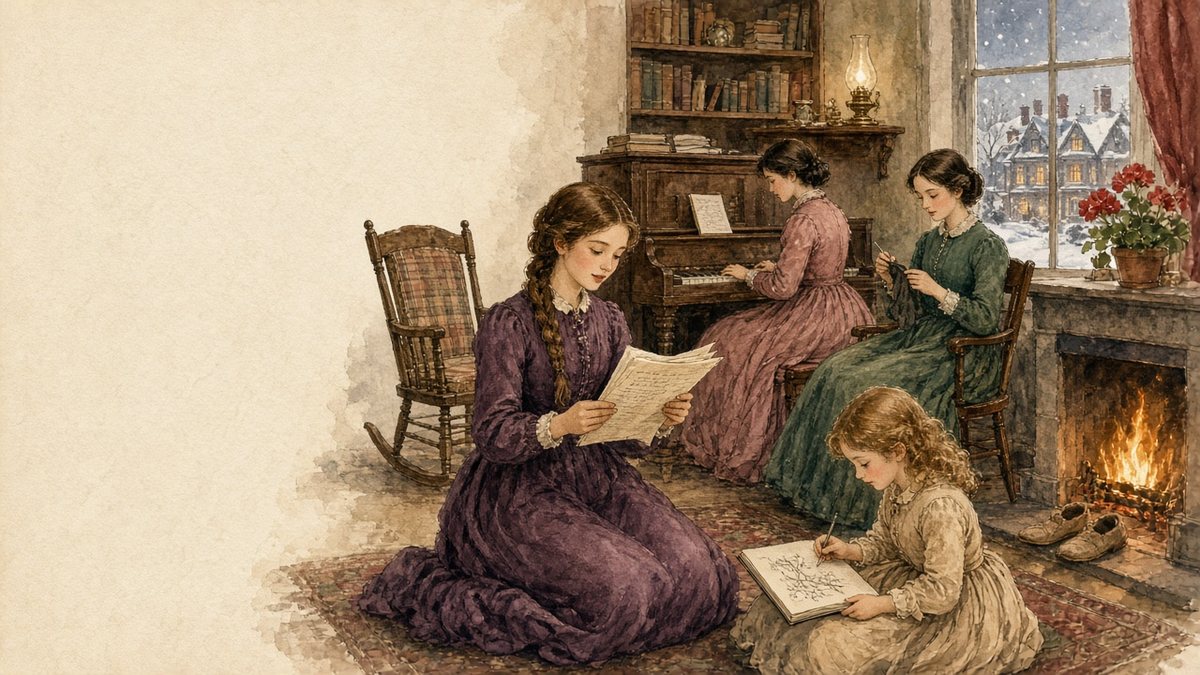
The March parlor on a winter evening. Original illustration made for Jugami.
The story in brief
Meg, Jo, Beth and Amy March live with their mother, Marmee, in a small New England town during the Civil War. Their father is away serving as an army chaplain, and the family has lost most of its money.
The sisters fight, make up, put on plays, make friends with Laurie, the lonely rich boy next door, and slowly learn to handle their faults. In Part Two they grow up: they find work, leave home, fall in love and face real loss. Each one has to decide what kind of woman she wants to be.
About the book: Part One came out in 1868 and Part Two in 1869. Today they are usually printed together as one novel with 47 chapters. Chapter numbers on this page follow that one-volume version.
Meet the March Sisters
At the start of the book the sisters are between 12 and 16. In Chapter 13, “Castles in the Air,” each one describes her dream life, which Alcott calls a castle in the air (a wonderful wish that may never come true). Watch what happens to those dreams.
Meg (Margaret)
The eldest · 16
Pretty, kind and responsible, Meg tries to be a second mother to her sisters. She works as a governess (a teacher who lives with or visits a family to teach its children). Her weakness is wanting nice things the family can’t afford.
Her castle in the air: “a lovely house, full of all sorts of luxurious things.”
Jo (Josephine)
The writer · 15
Tall, bold and funny, Jo writes plays and stories, climbs, runs, and hates being told to act like a “young lady.” Her biggest struggle is her quick temper. She works as a companion to cranky Aunt March.
Her castle in the air: to “write books, and get rich and famous.”
Beth (Elizabeth)
The quiet one · 13
Shy and gentle, Beth is so timid she studies at home. She loves music, her dolls and her family, and she quietly helps everyone. She is braver than she looks: she keeps visiting a poor family even when it is risky.
Her castle in the air: “to stay at home safe with Father and Mother, and help take care of the family.”
Amy
The youngest · 12
Artistic, a little vain, and fond of long words she sometimes gets wrong, Amy wants to be a proper, elegant lady. She can be selfish at first, but she grows into one of the most thoughtful people in the family.
Her castle in the air: “to be an artist, and go to Rome, and do fine pictures.”
Family, friends and neighbors
Marmee (Mrs. March)
The girls’ wise, warm mother. She works for families in need and soldiers’ aid, and gives her daughters honest advice, even admitting she struggles with anger herself.
Mr. March (Father)
Away for much of Part One as an army chaplain. In his Christmas letter he calls them “my little women.”
Laurie (Theodore Laurence)
The lively, lonely boy next door who lives with his grandfather. He becomes the sisters’ best friend and an honorary member of their club.
Mr. Laurence
Laurie’s gruff, rich grandfather. He seems scary at first, but he and shy Beth become close friends.
John Brooke
Laurie’s tutor: quiet, poor, honest and hard-working. He becomes important to Meg.
Aunt March
A wealthy, sharp-tongued great-aunt who hires Jo as her companion and has strong opinions about everyone’s future.
Hannah
The family’s cook and housekeeper, who has lived with them since Meg was born and is treated more like family than a servant.
Professor Bhaer
A kind, poor teacher from Berlin whom Jo meets in New York in Part Two. He is not handsome or rich, but he is honest with her about her writing.
Chapter Guide
The 47 chapters are grouped below into short stretches of story, the way you might read them in class. Each group lists its chapter titles, then tells you what happens.
Did you know? Many chapter titles in Part One borrow from The Pilgrim’s Progress, a 1678 book by John Bunyan about a traveler’s journey. The sisters treat growing up like that journey, each carrying her own burden (a heavy load, here meaning a fault or a hard job).
Part One · published 1868 · Chapters 1–23
One Year at Home
Part One covers about one year, from one Christmas to the next, while Father is away at the war.
Chapters 1–4
Christmas, and the Boy Next Door
Playing Pilgrims
A Merry Christmas
The Laurence Boy
Burdens
It’s the week before Christmas, and the girls each have one dollar. They decide to spend it on presents for Marmee instead of themselves. A letter from Father asks them to be brave and to “conquer themselves.”
On Christmas morning Marmee asks them to give their own breakfast to the Hummels, a poor German family with a sick baby, and they do. At a New Year’s Eve dance, Jo hides from the crowd and meets Laurie, the boy next door. Then we see each sister’s “burden”: Meg’s job as a governess, Jo’s days with Aunt March, Beth’s shyness, and Amy’s embarrassments at school.
Chapters 5–8
New Friends and a Terrible Temper
Being Neighborly
Beth Finds the Palace Beautiful
Amy’s Valley of Humiliation
Jo Meets Apollyon
Jo marches next door to cheer up Laurie when he is sick, and the two families become friends. Shy Beth is invited to play the Laurences’ grand piano, and old Mr. Laurence later gives her a little piano of her own.
Amy is punished at school for bringing pickled limes, a fad her classmates are trading. Then the biggest fight in the book: when Jo leaves Amy out of a trip to the theater, Amy burns the book Jo has been writing. Jo refuses to forgive her, until Amy falls through the ice while skating. Marmee tells Jo that she, too, has a temper and has spent years learning to control it.
Chapters 9–12
Vanity Fair, Clubs and a Summer Picnic
Meg Goes to Vanity Fair
The P.C. and P.O.
Experiments
Camp Laurence
Meg visits rich friends, the Moffats, who dress her up in borrowed finery. She has fun, but she feels foolish when she overhears gossip. The sisters run the Pickwick Club, named for a Charles Dickens novel, with its own weekly paper, and Laurie is voted in.
The girls beg for a vacation from chores. Marmee lets them try it, and the house falls apart, ending with a disastrous dinner Jo cooks. As Hannah says, “Housekeeping ain’t no joke.” Laurie hosts a picnic with English visitors.
Chapters 13–16
Dreams, Secrets and a Telegram
Castles in the Air
Secrets
A Telegram
Letters
On a hill, the friends share their castles in the air. Jo secretly sends two stories to a newspaper, and one is printed. Then a telegram (an urgent message sent by electric wire) arrives: Father is very sick in a hospital in Washington. Marmee must go at once.
To help pay for the trip, Jo sells her long hair for twenty-five dollars. Mr. Brooke goes with Marmee to Washington. The girls write letters full of brave news.
Chapters 17–19
Dark Days
Little Faithful
Dark Days
Amy’s Will
With Marmee gone, the other sisters slip back into old habits, but Beth keeps visiting the Hummels. The Hummel baby dies of scarlet fever in her lap, and Beth catches the disease. Amy is sent to stay with Aunt March to keep her safe, and she writes a will (a list of who gets her things) in case she dies too.
Beth becomes dangerously ill. Laurie quietly sends for Marmee. Beth survives the crisis just before her mother gets home.
Chapters 20–23
Pranks, Peace and a Proposal
Confidential
Laurie Makes Mischief, and Jo Makes Peace
Pleasant Meadows
Aunt March Settles the Question
Jo learns that Mr. Brooke loves Meg, and she hates the idea of losing her sister. Laurie plays a cruel prank with fake love letters, and Jo has to patch things up.
At Christmas, Father comes home at last. When Mr. Brooke proposes, Aunt March storms in and threatens to cut Meg off if she marries a poor man. Her bossiness backfires: Meg stands up for John and says yes. Part One ends with the family together and an engagement Jo can’t stand.
Part Two · published 1869 · Chapters 24–47
Growing Up and Moving Out
Part Two jumps ahead three years. The war is over, and the sisters are young women making real choices about work, art and love. (In Britain this part was sold as a separate book, often called Good Wives.)
Chapters 24–28
A Wedding and Some Experiments
Gossip
The First Wedding
Artistic Attempts
Literary Lessons
Domestic Experiences
Meg marries John Brooke in a simple wedding at home. Amy tries many kinds of art, from clay to oil paint. Jo wins a prize for a story and learns how hard it is to please editors and critics.
Meg, as a new wife, learns that running a home is harder than it looks (her jelly refuses to set) and has twins.
Chapters 29–34
Europe and New York
Calls
Consequences
Our Foreign Correspondent
Tender Troubles
Jo’s Journal
Friend
Polite, patient Amy is chosen instead of blunt Jo to travel to Europe with Aunt Carrol and her cousin Flo, and she writes home about it. Jo is disappointed, and decides she needs a change.
Jo goes to New York to teach children at a boarding house run by Marmee’s friend Mrs. Kirke. There she meets Professor Bhaer. She earns money writing sensational stories (shocking, thrilling tales) for a paper called the Weekly Volcano, until she sees them through Bhaer’s honest eyes and burns them.
Spoiler warning. The rest of the chapter guide reveals major events from the end of the book, including what happens to Beth, and who marries whom. If you haven’t finished reading, you may want to stop here. Open the box when you’re ready.
Show Chapters 35–47 (spoilers)
Chapters 35–39
Heartache and Beth’s Secret
Heartache
Beth’s Secret
New Impressions
On the Shelf
Lazy Laurence
Back home, Laurie tells Jo he loves her. Jo cares about him as a friend but says no, and Laurie leaves for Europe heartbroken. Jo learns Beth’s secret: Beth has never fully recovered from scarlet fever, and she knows she will not get well.
In Europe, Amy meets Laurie again. She bluntly tells him to stop moping and do something useful with his life. At home, Meg is so busy with her twins, Daisy and Demi, that she neglects her husband, until Marmee helps her find balance.
Chapters 40–42
The Valley of the Shadow
The Valley of the Shadow
Learning to Forget
All Alone
Beth dies peacefully, surrounded by her family. Alcott writes it gently, but it is the saddest part of the book.
In Europe, Laurie works to change, and he and Amy grow closer. At home, Jo is lonely and grieving. She tries to take over Beth’s role of caring for everyone, and her mother encourages her to write again, this time from her own heart.
Chapters 43–47
Surprises and Harvest Time
Surprises
My Lord and Lady
Daisy and Demi
Under the Umbrella
Harvest Time
Laurie and Amy come home married. Professor Bhaer visits, and during a walk in the rain, under his umbrella, he and Jo admit that they love each other.
When Aunt March dies, she leaves her big house, Plumfield, to Jo. Jo and the Professor turn it into a happy, homelike school for boys. The book ends at a family harvest gathering, with each sister thinking about how her castle in the air turned into something different, and in some ways better.
Who Was Louisa May Alcott?
Louisa May Alcott was born on November 29, 1832, in Germantown, Pennsylvania. She grew up mostly in Boston and Concord, Massachusetts, the second of four sisters. Her family was often poor, so Louisa worked from a young age as a teacher, a seamstress, a governess and a writer.
In 1868 her publisher, Thomas Niles of Roberts Brothers in Boston, asked her for “a girls’ story.” She wasn’t excited about the idea at first. But she sat down at a little desk her father built for her and wrote Part One in about ten weeks, from May to July 1868. It was an instant hit. She wrote Part Two in late 1868, and it came out in 1869. Later came the sequels Little Men (1871) and Jo’s Boys (1886). She died in Boston on March 6, 1888.
Was Jo real?
Mostly, yes. Alcott based Jo on herself: a tomboy who loved to write and had a temper. She based the other sisters on her own sisters, though she changed many details.
Where was it written?
At Orchard House in Concord, Massachusetts, where the Alcotts lived from 1858 to 1877. Many scenes, like the sisters’ homemade plays, come from real life there. The house is a museum today.
Why “March”?
Louisa’s middle name was May, a month. For the fictional family she picked another month, March, a colder and rougher one.
Did Louisa go to war?
Yes. In the winter of 1862–63 she served as a Union nurse at a hospital in Georgetown, in Washington, D.C., until she became seriously ill with typhoid pneumonia. She wrote about it in Hospital Sketches (1863).
Is the town Concord?
The book never names the town, but Alcott drew on Concord for the Marches’ New England village. Concord is where the Alcotts lived among famous neighbors like Ralph Waldo Emerson and Henry David Thoreau.
Why is there a Part Two?
Readers loved Part One and wrote letters demanding to know what happened next, and especially whom the girls married. Alcott wrote Part Two that fall and winter, and it was published in 1869.
The real family behind the March family
Heads-up: one row mentions a real death that shaped the end of the novel.
Members of the March family and the real Alcotts they were based on
In the book
In real life
What they shared
Meg
Anna Alcott, the eldest
Loved acting in the sisters’ plays. Like Meg, she married at home: she wed John Pratt in the Orchard House parlor on May 23, 1860.
Jo
Louisa May Alcott
A writer with a temper and a hunger for independence. Unlike Jo, Louisa never married.
Beth
Elizabeth (“Lizzie”) Alcott
Shy, gentle and musical. She caught scarlet fever in 1856 after helping a poor family and died in 1858.
Amy
Abigail May Alcott, called May
A talented artist who studied in Europe. May drew the illustrations for the first edition of Little Women.
Marmee
Abigail May Alcott, their mother
Hard-working, caring and active in helping others.
Mr. March
Amos Bronson Alcott, their father
A teacher and thinker. Unlike Mr. March, he did not serve in the army.
The World of the Book: The Civil War Years
The book never names the war, but readers understand it as the American Civil War (1861–1865), the war between the Union (the Northern states) and the Confederacy (the Southern states), fought largely over slavery. Part One takes place during those years. The fighting is far away from the Marches’ town, but you can feel it in almost every chapter.
A father at war
Mr. March went to serve as a chaplain (a minister who cares for soldiers) because he was “too old to be drafted, and not strong enough for a soldier,” as Meg puts it.
Sacrifice at home
Marmee suggests no presents one Christmas because “our men are suffering so in the army.” Families on the home front sewed and packed supplies for soldiers.
News by telegram
There were no phones yet. Bad news from the front or a hospital usually came by telegram or letter, and families waited anxiously for both.
Few jobs for women
Middle-class young women had limited choices for paid work: teaching, sewing, being a governess or a companion. Writing for magazines, as Jo (and Louisa) did, was one way to earn real money.
Poor but “genteel”
The Marches used to have money and still have good manners and educated friends. That’s why Meg feels the sting of shabby gloves and borrowed dresses so sharply.
What kids did for fun
No screens: the sisters write plays, publish a homemade newspaper, read Dickens and Bunyan, skate, row, and play the piano.
Big Themes
Family and sisterhood
The sisters quarrel constantly, and they would also do anything for each other. The book asks what holds a family together when money is short and a parent is away.
Growing up
Each sister has to leave childhood behind. Jo especially fights it: “I hate to think I’ve got to grow up.” Is growing up a loss, a gain, or both?
Work and money
Being poor is hard, but the book suggests that honest work and a loving home matter more than wealth. Notice who is happy, and who just looks happy.
Dreams and ambition
Jo wants fame as a writer and Amy wants to be a great artist. The book takes their talents seriously and also shows how dreams change as people grow.
Fighting your own faults
Father hopes his girls will “fight their bosom enemies bravely.” Meg’s vanity, Jo’s temper, Beth’s shyness and Amy’s selfishness are each sister’s real battle.
What a woman can be
In the 1860s many people thought girls should be quiet and ladylike. Jo is loud and ambitious, and she wants a life of her own.
Pick the answer that sounds most like you for each question, then press “Show my sister.” There are no wrong answers, and you can try again as many times as you like.
Little Women Quiz
Eight questions about Part One and the author (no Part Two spoilers). Choose one answer for each, then press “Check my answers” to see your score and why each answer is right.
Talk About It
These questions have no single right answer. Use them with a class, a book club or your family.
Which sister’s “burden” seems hardest to you? Which one is most like a problem kids still have today?
Marmee tells Jo she is angry “nearly every day.” Why do you think she admits that? Does it make her a better or worse role model?
Jo forgives Amy only after Amy nearly drowns. Should it have taken a near-disaster? What else could have ended their fight?
The war is far away, yet it changes the Marches’ lives. How do big world events reach into ordinary homes, then and now?
Meg is embarrassed about being poor at the Moffats’ party. Is it wrong to want nice things? Where is the line between enjoying things and caring too much about them?
Compare the sisters’ castles in the air with what they really end up doing. Is it a happy ending if your dream changes?
Which sister do you think Laurie belongs with, and why?
Alcott built the story from her own family. If you wrote a novel about your family, what would you keep true and what would you change?
Edition, Sources and Credits
Louisa May Alcott, Little Women (Boston: Roberts Brothers, Part One 1868, Part Two 1869). Quotations and chapter titles are from the public-domain one-volume text, Project Gutenberg eBook #514.
Art: The parlor watercolor is an original illustration generated for Jugami. The sister emblems and part icons are hand-made SVG drawings. No outside images are used.