
Snow White
Little Snow-White
Schneewittchen
Once upon a time in the middle of winter, when snowflakes were falling like feathers from the sky, a queen sat sewing at a window with a frame of black ebony. As she looked out at the snow she pricked her finger, and three drops of blood fell onto the snow. The red looked so lovely against the white that she thought, If only I had a child as white as snow, as red as blood, and as black as the wood of this window frame. Soon after, she had a little daughter with skin as white as snow, cheeks as red as blood and hair as black as ebony, and she was called Snow White. When the child was born, the queen died.
A year later the king married again. His new wife was beautiful but proud and arrogant, and she could not bear for anyone to be more beautiful than she. She owned a magic mirror, and whenever she stood before it and asked, “Mirror, mirror, on the wall, who in this land is fairest of all?” it answered, “You, my queen, are fairest of all.” Then she was content, for she knew the mirror told the truth.
But Snow White grew, and when she was seven years old she was as beautiful as the bright day, more beautiful than the queen herself. One day the mirror answered, “You, my queen, are fair, it is true, but Snow White is a thousand times fairer than you.” The queen turned yellow and green with envy. From that hour, whenever she saw Snow White, her heart turned over in her breast, and her envy and pride grew like weeds until she had no peace by day or night.
She summoned a huntsman. “Take the child out into the forest. I never want to see her again. Kill her and bring me her lungs and liver as proof.” The huntsman led Snow White away, but when he drew his knife she began to cry and begged for her life, promising to run into the wild forest and never come home. Because she was so beautiful, he took pity on her. “Run away then, poor child,” he said, thinking the wild animals would soon finish her anyway. Still, it felt as if a stone had been lifted from his heart. A young boar came running by; he killed it and took its lungs and liver to the queen, who had them cooked and ate them, believing they were Snow White’s.
Alone in the great forest, Snow White ran over sharp stones and through thorns, and wild animals sprang past her without harming her. At evening she came upon a little cottage where everything was tiny, neat and clean: a little table with seven little plates, seven little cups, and seven little beds in a row. She was so hungry that she ate a little bread and vegetables from each plate and drank a drop of wine from each cup, so as not to take everything from one. Then she tried the beds, found the seventh just right, and fell asleep.
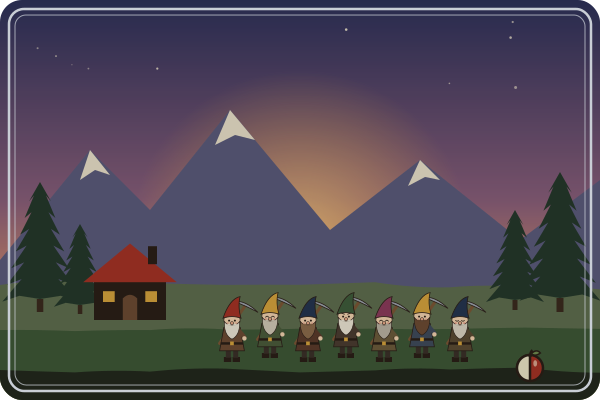
The owners of the cottage were seven dwarfs who dug in the mountains for ore. When they came home they saw at once that someone had been there. “Who has been sitting on my chair? Who has been eating off my plate?” they asked, until they found the girl asleep. They were so delighted by her that they let her sleep. In the morning she told them her story, and they said, “If you will keep house for us, cook, make the beds, wash, sew and knit, you can stay with us and want for nothing.” But they warned her: “Beware of your stepmother. She will soon know you are here. Don’t let anyone in.”
The queen asked her mirror again, and it answered that Snow White, over the mountains with the seven dwarfs, was still a thousand times fairer. Realising she had been deceived, she disguised herself as an old peddler woman and went to the cottage selling laces. She offered to lace Snow White’s bodice properly, and pulled it so quickly and tightly that the girl’s breath was cut off and she fell down as if dead. The dwarfs came home just in time, cut the lace, and she revived. The next time the queen came with a poisoned comb; as soon as it touched Snow White’s hair she fell senseless, but the dwarfs pulled it out and she awoke.
Then the queen, shaking with rage, went to a secret room and made a deadly apple: white with red cheeks, so tempting that anyone who saw it would long for it, but anyone who ate a bite would die. Disguised as a farmer’s wife, she offered it through the window. “Are you afraid of poison? Look, I’ll cut it in two. You eat the red half and I’ll eat the white.” Only the red half was poisoned. Snow White longed for the apple, and seeing the woman eat, she took the poisoned half. She had barely taken a bite when she fell down dead. The queen laughed aloud. “White as snow, red as blood, black as ebony! This time the dwarfs cannot wake you!” And at last the mirror said she was the fairest of all, and her envious heart had rest, as far as an envious heart can.
The dwarfs could not revive her. They could not bear to bury her in the dark earth, for she still looked fresh and rosy, as if asleep. So they made a coffin of glass, wrote her name on it in gold letters, set it on a mountain and always kept one of themselves beside it. The birds came to mourn her too: first an owl, then a raven, last of all a dove.
Snow White lay in the coffin for a long, long time. Then a king’s son came to the dwarfs’ house, saw her and begged them to let him have the coffin, for he could not live without looking at her. Moved by his love, they gave it to him. As his servants carried it away, they stumbled over a shrub, and the jolt shook the poisoned piece of apple from her throat. Snow White opened her eyes, raised the lid and sat up, alive. The prince told her everything and asked her to be his wife, and she gladly agreed.
The wicked queen was invited to the wedding. When her mirror told her that the young queen was a thousand times fairer, she could not stay away. She recognised Snow White and stood frozen with rage and fear. But a pair of iron slippers had already been heated over a fire. They were brought in with tongs and set before her, and she had to step into the red-hot shoes and dance until she fell down dead.