
Hansel and Gretel
Hänsel und Gretel
At the edge of a great forest lived a poor woodcutter with his wife and his two children, a boy named Hansel and a girl named Gretel. When a great famine came over the land, there was not even bread enough to eat. One night, tossing with worry, the woodcutter asked his wife what was to become of them. “Tomorrow,” she said, “we will take the children deep into the forest, light them a fire, give each a piece of bread, and leave them. They will never find their way home, and we will be rid of them.” The father refused at first, but she gave him no peace until he agreed.
The children, too hungry to sleep, had heard everything. Gretel wept bitterly, but Hansel whispered, “Don’t worry, I’ll find a way.” When the parents were asleep, he crept outside. The moon was shining brightly, and the white pebbles in front of the house glittered like silver coins. Hansel filled his pockets with them.
At dawn the woman woke them and led them into the forest. Hansel kept stopping to look back at the house. “I’m looking at my little white cat on the roof,” he said. “Fool, that’s the morning sun on the chimney,” the woman snapped. But all the while Hansel was dropping pebbles along the path. Deep in the woods the parents built a fire and left them. The children waited until night fell, and then, when the full moon rose, they followed the pebbles, which shone like new coins, all the way home. Their father was overjoyed; the woman pretended to be.
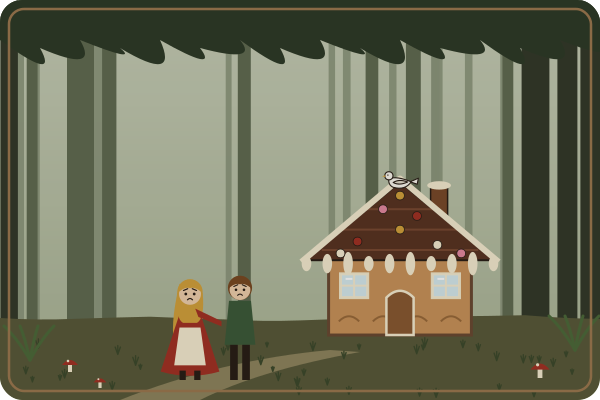
Soon the famine grew worse, and the woman insisted they try again. This time she locked the door, so Hansel could not gather pebbles. On the way into the forest he crumbled his bread and dropped the crumbs instead. But when the moon rose there were no crumbs to be seen: the thousands of birds of the forest had eaten them all. The children wandered for three days, getting ever deeper into the woods. Then a beautiful snow-white bird sang to them and led them to a little house built of bread, roofed with cake, with windows of clear sugar.
Starving, they began to eat. A gentle voice called from inside: “Nibble, nibble, little mouse, who is nibbling at my house?” The children answered, “The wind, the wind, the heaven-born wind,” and went on eating. Then the door opened and a very old woman, leaning on a crutch, came out. She led them inside, fed them milk and pancakes with sugar, apples and nuts, and put them to bed in little white beds.
But the old woman was only pretending to be kind. She was a wicked witch who lay in wait for children and had built her bread house only to lure them in. Whenever a child fell into her power, she killed it, cooked it and ate it. Witches have red eyes and cannot see far, but like animals they have a keen sense of smell.
In the morning she seized Hansel, locked him in a little stable behind a barred door, and forced Gretel to cook the best food for him so that he would grow fat; Gretel herself got nothing but crab shells. Each morning the witch cried, “Hansel, stick out your finger so I can feel if you’re fat yet!” But clever Hansel held out a little bone, and the dim-eyed witch could not understand why he never fattened. After four weeks she lost patience. “Fat or thin, tomorrow I will cook him.”
The next morning she lit the oven and pushed Gretel toward it. “Crawl in and see if it’s hot enough for the bread.” She meant to shut the door and roast Gretel too. But Gretel saw what she intended. “I don’t know how. How do I get in?” “Silly goose,” said the witch, “the opening is big enough. Look, I could get in myself!” and she stuck her head into the oven. Gretel gave her a mighty shove, slammed the iron door and bolted it. The witch began to howl horribly, but Gretel ran away, and the wicked witch burned to death.
Gretel freed Hansel, and the two danced for joy. In the witch’s house they found chests of pearls and jewels and filled their pockets. On their way home they reached a wide water with no bridge, but a white duck carried them across one at a time. At last they saw their father’s house. He had not had a single happy hour since leaving them in the forest, and the woman had died. Gretel shook out her apron, and pearls and jewels bounced across the floor. Their troubles were over, and they lived together in perfect happiness.