
The Elves and the Shoemaker
Die Wichtelmänner
There was once a shoemaker who, through no fault of his own, had become so poor that at last he had only enough leather left for one single pair of shoes. In the evening he cut out the leather, meaning to sew the shoes the next morning. Since he had a clear conscience, he lay down quietly in his bed, said his prayers and fell asleep.
In the morning he found the two shoes standing finished on his table, so neatly made that there was not one bad stitch in them, a real masterpiece. A customer soon came in, liked them so much that he paid more than the usual price, and with that money the shoemaker bought leather for two pairs. He cut them out that evening, and by morning they were finished too. The next buyers paid enough for four pairs, and those were also done by dawn. And so it went on: whatever he cut out at night was finished by morning, until he had an honest living again and at last became well-to-do.
One evening not long before Christmas, when the shoemaker had cut out the leather as usual, he said to his wife before bed, “What if we stayed up tonight to see who it is that gives us such a helping hand?” His wife agreed, so they left a candle burning and hid in a corner behind some hanging clothes.
At midnight two tiny, pretty little men came in, without a stitch of clothing on. They sat down at the table and began to stitch, sew and hammer so nimbly that the shoemaker could not take his eyes off them, and they did not stop until every shoe was finished. Then they ran swiftly away.
The next morning the wife said, “The little men have made us rich, and we ought to show them our thanks. They run about with nothing on and must be freezing. I know what: I will sew them little shirts, coats, waistcoats and trousers, and knit each of them a pair of stockings, and you make them each a little pair of shoes.” The husband said, “I am happy to,” and they set to work. In the evening, when everything was ready, they laid out the presents on the table instead of the cut-out leather, and hid again to see what the little men would do.
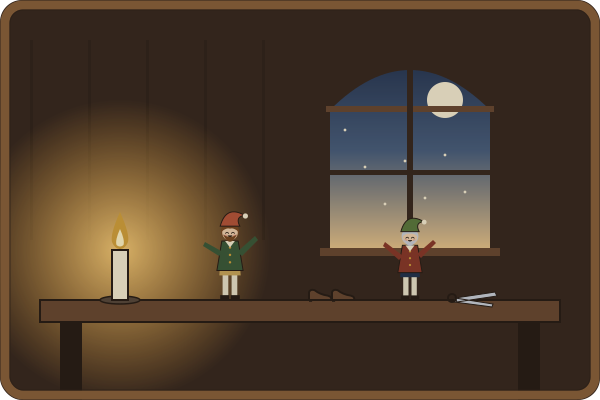
At midnight the elves came skipping in, ready to work. But when they found no leather, only the charming little clothes, they were at first astonished, and then overjoyed. In great haste they dressed themselves, smoothed down their fine new clothes and sang:
“Now we’re boys so fine to see, why should we longer cobblers be?”
Then they hopped and danced and leapt over chairs and benches, until at last they danced right out of the door. From that time on they never came back. But the shoemaker did well for as long as he lived, and everything he undertook prospered.
The other two elf tales. The Grimms paired this story with two shorter ones. In the second, a hard-working servant girl is invited by the elves to be godmother at a christening inside a hollow mountain; she stays what feels like three days, but when she returns home a whole seven years have passed. In the third, elves steal a mother’s baby from its cradle and leave a changeling with a big head and staring eyes. On a neighbour’s advice she boils water in eggshells in front of it; the changeling laughs, saying he is as old as the forest yet has never seen anyone cook in eggshells! At once the elves return her own child.