The Dust Bowl
Drought, dust and migration on the Great Plains, 1931 to 1939
While banks failed and factories closed in the cities, a different disaster struck the southern Great Plains. Years of drought dried out land that farmers had stripped of its grass, and the wind lifted the soil into enormous dust storms. Crops died, livestock starved, and many families lost their farms.
This unit, the third in the course, asks how farmers and nature together made the Dust Bowl, what life was like inside it, why so many people left, and how the government tried to heal the land.
Breaking the Plains
The southern Plains, where Kansas, Colorado, Oklahoma, Texas and New Mexico meet, get little rain, and wet and dry years come and go. For thousands of years, deep-rooted prairie grasses held the soil in place. Bison and, later, cattle grazed on them.
In the late 1800s and early 1900s, homestead laws drew settlers onto the dry land. Many believed a slogan, “rain follows the plow”: farming would somehow bring more rain. A run of wet years seemed to support the idea, but the region’s climate had not changed. Those wet years were part of a natural cycle, and dry years would return.
During World War I, Europe needed food, and the government guaranteed wheat prices above $2 a bushel. Farmers plowed more land, and in the 1920s new tractors and combines let one family farm far more acres than horses ever could. Historians call these years the Great Plow-Up: millions of acres of native sod were turned under for wheat. When prices fell after the war, many farmers plowed even more to make up the difference, and they borrowed to buy land and machines.
Drought and Black Blizzards
In 1931 farmers harvested a huge wheat crop just as the Depression drove prices down to well under half a dollar a bushel. Many could not pay their costs and left fields bare. Then the rain stopped. Drought gripped much of the Plains, with only a few breaks, until 1939, and the heat set records in 1934 and 1936.
Without grass or crops to hold it, the dry topsoil blew away. Dust storms grew larger, and their number rose and fell from year to year, peaking at 72 regional storms in 1937. Some, called black blizzards, turned noon as dark as night. In May 1934 a storm carried Plains dust all the way to Chicago, New York and Washington, D.C., and onto ships far out in the Atlantic. Estimates of the dirt it carried run to hundreds of millions of tons.
The worst storm came on Black Sunday, April 14, 1935. After a clear, warm morning, a wall of dust swept south from the Dakotas and Nebraska. The Weather Bureau in Dodge City, Kansas, recorded its arrival at 2:49 in the afternoon and estimated the cloud at 500 to 600 feet high and moving 50 to 60 miles an hour. It reached Boise City, Oklahoma, after 5 p.m. and Amarillo, Texas, after 7. The next day, an Associated Press reporter wrote about the “dust bowl,” and the name stuck.
Life in the Dust
Families stuffed wet rags around windows and doors, yet dust still covered beds, food and dishes. People wore masks or damp cloths over their faces. Static electricity from the storms could short out car engines. Cattle went blind or choked, and swarms of grasshoppers and jackrabbits ate what little grew.
Breathing the fine dust caused a lung illness that people called dust pneumonia. It was most dangerous for babies and the old. After Black Sunday, the Red Cross reported 17 deaths from it in Kansas alone. No one knows how many died across the whole region.
Farmers who could not pay their mortgages faced foreclosure. In the farm belt, especially in the Midwest, neighbors sometimes fought back with penny auctions: at a foreclosure sale they kept other buyers away, bid a few cents for the land, animals and tools, and gave them back to the owner. Federal programs bought starving cattle in 1934, and relief work kept many families going.
The Migrants
Many families stayed through the whole decade. Many others gave up. Historians estimate that about 2.5 million people moved out of the Plains states during the 1930s. Not all of them came from the dust-blown counties. Many were tenant farmers and sharecroppers from Oklahoma, Arkansas, Texas and Missouri, pushed off by drought, low prices and landowners who replaced them with tractors.
Hundreds of thousands drove west on Route 66 to California, often in old cars piled with everything they owned. Californians called them “Okies,” wherever they came from, and many treated them as unwanted outsiders. In February 1936 the Los Angeles police sent officers to the state’s borders to turn back poor travelers. Critics called this “bum blockade” illegal, and it ended that spring.
Most migrants found only seasonal work picking crops for low pay. They lived in roadside camps and ditch-bank shacks. The federal government built a number of clean migrant camps, such as the one at Arvin, with tents or cabins, showers and a camp council run by the residents.
Seeing the Dust Bowl
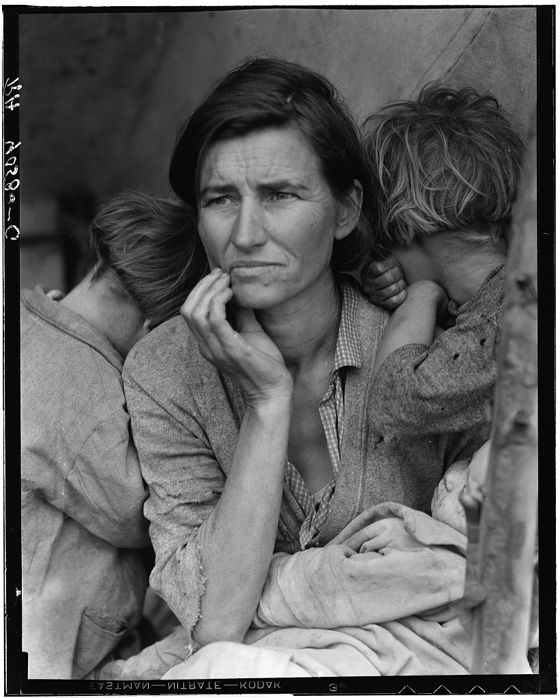
Most Americans learned about the Dust Bowl from photographs, films, books and songs. The Resettlement Administration, which later became the Farm Security Administration (FSA), hired photographers to record rural poverty and to build support for its programs. In March 1936 Dorothea Lange stopped at a pea pickers’ camp in Nipomo, California, and photographed a mother with her children. The picture, now called “Migrant Mother,” became one of the most famous images of the Depression.
In 1936 the government also released The Plow That Broke the Plains, a short documentary by Pare Lorentz. In 1939 John Steinbeck published The Grapes of Wrath, a novel about the Joads, a fictional Oklahoma family who lose their farm and travel to California, where growers exploit them. It became a bestseller and won the Pulitzer Prize, but some California officials burned or banned it, calling it unfair to their state. A film version followed in 1940.
The folk singer Woody Guthrie grew up in Oklahoma and lived in Pampa, Texas, when Black Sunday hit. He traveled west with the migrants and wrote songs about the storms, the camps and the people. In 1940 he recorded them on the album Dust Bowl Ballads.
Healing the Land
The government responded in several ways. The Agricultural Adjustment Act of 1933 paid farmers to plant less, to raise prices. Federal drought programs bought millions of starving cattle and gave relief jobs and loans to farm families.
The soil scientist Hugh Hammond Bennett had warned for years that erosion was a national danger. In September 1933 he was put in charge of a new Soil Erosion Service in the Department of the Interior. In March 1935 the service moved to the Department of Agriculture, and on April 27, 1935, Roosevelt signed the Soil Conservation Act, which made it the permanent Soil Conservation Service (SCS), with Bennett as its chief. A story often told says that, while Bennett spoke to Congress that spring, a dust storm from the Plains darkened the Washington sky.
The SCS paid and taught farmers to farm in new ways. Contour plowing followed the curves of the land so furrows caught rain. Farmers planted cover crops and grass, left stubble on the fields and plowed strips that broke the wind. Starting in 1937, states let farmers form soil conservation districts to plan this work together. The Forest Service’s Shelterbelt project planted rows of trees across the Plains, an estimated 220 million trees by 1942.
Rain returned in the fall of 1939, and by the early 1940s high wartime prices brought good times back to Plains farms.
Legacy and Lessons
The Dust Bowl was one of the worst environmental disasters in American history. Drought was natural, but the damage was not only nature’s doing. Plowing up the grassland, farming for quick profits and the collapse of prices all left the land exposed. Many historians see it as a lesson in what happens when people farm against the limits of the land.
The Soil Conservation Service still exists as the Natural Resources Conservation Service. Droughts struck the Plains again in the 1950s and later, but conservation methods kept them from becoming another Dust Bowl. Today scientists also watch the falling water in the Ogallala Aquifer, which irrigates much of the region. Unit 4 looks at the New Deal, the larger program that created the SCS and many other agencies.
Timeline, 1909 to 1940
Select an event to open it. Use the buttons to show only one kind of event.
Dot colors: land and farming drought and dust people and culture government response
1909 Enlarged Homestead Act land and farming
Congress offers settlers 320 acres of dry western land, double the old homestead size, drawing more farmers onto the Plains.
1917 Wartime wheat boom land and farming
With the United States in World War I, the government guarantees wheat prices above $2 a bushel, and farmers plow more grassland.
1920s The Great Plow-Up land and farming
Tractors and combines let farmers break millions of acres of prairie sod in the southern Plains.
1931 Wheat prices collapse land and farming
A record harvest meets the Depression, and wheat falls to well under half a dollar a bushel. Rain stops in much of the region.
1932 Dust storms increase drought and dust
The Weather Bureau records 14 regional dust storms. The count peaks at 72 in 1937.
1933 AAA and soil erosion work government response
The Agricultural Adjustment Act pays farmers to grow less. In September the Soil Erosion Service is set up under Hugh Hammond Bennett.
1934 Dust reaches the East drought and dust
In May a great storm carries Plains dirt to Chicago, New York and Washington, and onto ships in the Atlantic.
1934 Cattle buying and the Shelterbelt government response
Federal drought relief buys and slaughters starving cattle, and the government begins planting a belt of trees across the Plains.
1935 Black Sunday drought and dust
On April 14 a huge wall of dust sweeps across Kansas, Oklahoma and Texas. The next day the region is first called the “Dust Bowl.”
1935 Soil Conservation Service government response
In March the Soil Erosion Service moves to the Department of Agriculture. On April 27 Roosevelt signs the Soil Conservation Act, which makes it the permanent Soil Conservation Service under Bennett.
1936 “Bum blockade” government response
In February Los Angeles police officers are sent to California’s borders to turn back poor migrants. Critics call it illegal, and it ends that spring.
1936 Migrant Mother people and culture
In March Dorothea Lange photographs a migrant mother and her children at a pea pickers’ camp in Nipomo, California.
1936 The Plow That Broke the Plains people and culture
A government documentary film by Pare Lorentz shows how plowing and drought ruined the grassland.
1937 Soil conservation districts government response
Washington sends states a model law that lets farmers form districts to plan soil conservation together.
1939 The Grapes of Wrath people and culture
John Steinbeck publishes his novel about an Oklahoma family that loses its farm and heads for California.
1939 The rains return drought and dust
Steady rain falls in the fall of 1939, and the worst of the dust storms end.
1940 Dust Bowl Ballads people and culture
Woody Guthrie, who lived through Black Sunday in Pampa, Texas, records an album of songs about the dust and the migrants.
Activity: Human or Natural Cause?
Several answers can be defended with evidence. Many causes of the Dust Bowl mixed human choices with forces of nature. For each example, decide whether it was mainly a human cause, mainly a natural cause, or both.
Breaking the Land
1910s and 1920s
Farmers plow up the native grass to plant wheat.
Wheat prices rise during World War I.
Tractors let one family plow far more land.
Settlers believe that rain will follow the plow.
The southern Plains have dry spells every few decades.
Sort each example to see where you lean.
The Dirty Thirties
1931 to 1935
Years pass with far less rain than normal.
Bare fields are left unplanted when prices fall.
Strong spring winds sweep across the open land.
A black blizzard turns the afternoon dark.
Plagues of grasshoppers and jackrabbits eat the crops.
Sort each example to see where you lean.
Leaving and Staying
1935 to 1940
A family loses its farm to the bank.
Children fall ill from breathing the dust.
Landowners replace tenant farmers with tractors.
Hundreds of thousands of migrants head for California.
The rains return in the fall of 1939.
Sort each example to see where you lean.
Your turn: pick one example you marked “Both.” In two sentences, explain which part was human and which part was natural.
Primary Sources
5 short excerpts, checked word for word against the archive copies listed below.
“The onrushing cloud, the darkness, and the thick, choking dirt, made this storm one of terror and the worst, while it lasted, ever known here.”
This is an official weather record, so it describes the storm in plain terms. We have it as the National Weather Service quotes it today, not from the original log book. It speaks for one town; the same storm reached other places at other hours.
“Destitute pea pickers in California. Mother of seven children. Age thirty-two. Nipomo, California.”
This is the caption under which the Library of Congress catalogs the photograph now called “Migrant Mother.” Lange did not record the woman’s name. Decades later she was identified as Florence Owens Thompson, who said she was never paid and that some details reported about her were wrong. Her family had come from Oklahoma, but they were not dust farmers.
“I saw drought devastation in nine States. … I shall never forget the fields of wheat so blasted by heat that they cannot be harvested.”
Roosevelt gave this radio talk after touring the drought states, two months before he ran for reelection. He wanted listeners to support his relief programs, so it is both a report and an argument.
“Spending like this is not waste. It would spell future waste if we did not spend for such things now.”
Here Roosevelt defends spending on work projects such as soil erosion control and farm roads. Critics at the time said such spending was wasteful, which is why he answers them directly.
“No cracked earth, no blistering sun, no burning wind, no grasshoppers are a permanent match for the indomitable American farmers and stockmen and their wives and children who have carried on through desperate days, and inspire us with their self-reliance, their tenacity and their courage.”
This praise of farm families is meant to lift spirits. It leaves out the many families who could not carry on and left the Plains.
Key Terms
- Great Plains
- The dry, mostly flat grassland between the Mississippi Valley and the Rocky Mountains.
- Great Plow-Up
- The rapid plowing of Plains grassland for wheat from World War I through the 1920s.
- “Rain follows the plow”
- A popular but false belief that farming and settlement would make the dry West rainier.
- Sod
- The top layer of soil held together by grass roots; on the Plains it kept the soil from blowing away.
- Drought
- A long period with far less rain than normal.
- Wind erosion
- The loss of topsoil carried off by the wind.
- Black blizzard
- A dust storm so thick it turned day into night.
- Dust pneumonia
- A lung illness blamed on breathing fine dust; it could be deadly for babies and the old.
- Foreclosure
- The taking of a farm or home by a lender when the owner cannot repay the loan.
- Penny auction
- A foreclosure sale where neighbors bid only pennies and then gave the farm back to its owner.
- Okie
- A name, often an insult, for migrants to California from Oklahoma and nearby states.
- Soil Conservation Service (SCS)
- A permanent federal agency set up in 1935 to teach and pay farmers to protect their soil.
- Contour plowing
- Plowing across a slope along its natural curves, so furrows hold water and soil in place.
- Shelterbelt
- A row of trees planted to break the wind and protect fields.
Discussion Questions
- Was the Dust Bowl mainly a natural disaster or a human-made one? Use at least two pieces of evidence from the unit.
- Many Plains families stayed through the worst years. Why might a family stay rather than leave? Why might another family go?
- Dorothea Lange’s photographs were made for a government agency that wanted support for its programs. Does that make them less useful as evidence? Explain.
- Californians in the 1930s often treated migrants from the Plains as outsiders. How does their treatment compare with that of Mexican Americans in Unit 2?
- What lessons from the Dust Bowl apply to farming, water and climate today? Pick one and explain.
Test Yourself
10 questions on the Dust Bowl. Click an answer to check it.
Drought, Dust and Migration
Sources and Further Reading
Primary sources quoted
- U.S. Weather Bureau office log, Dodge City, Kansas, April 14, 1935, as quoted by the National Weather Service. National Weather Service, Dodge City, Kansas: www.weather.gov.
- Caption for Dorothea Lange’s photograph, March 1936. Library of Congress, Prints and Photographs Division: www.loc.gov.
- Franklin D. Roosevelt, fireside chat, September 6, 1936. The American Presidency Project, UC Santa Barbara: www.presidency.ucsb.edu.
- Franklin D. Roosevelt, fireside chat, September 6, 1936. The American Presidency Project, UC Santa Barbara: www.presidency.ucsb.edu.
- Franklin D. Roosevelt, fireside chat, September 6, 1936. The American Presidency Project, UC Santa Barbara: www.presidency.ucsb.edu.
Further reading
- National Weather Service, Norman, Oklahoma, “Black Sunday, April 14, 1935”: www.weather.gov
- National Weather Service, Dodge City, Kansas, “Black Sunday”: www.weather.gov
- Library of Congress, Dorothea Lange, “Destitute pea pickers in California” (Migrant Mother): www.loc.gov
- Library of Congress, Farm Security Administration/Office of War Information photographs: www.loc.gov
- Library of Congress, “Voices from the Dust Bowl” recordings of migrant camps: www.loc.gov
- PBS, Ken Burns, The Dust Bowl: www.pbs.org
- Miller Center, University of Virginia, “Franklin D. Roosevelt”: millercenter.org
- NOAA and partners, National Integrated Drought Information System, drought.gov: www.drought.gov